Monday, July 14, 2014

Conservation of The Peoples Choice: Alexander Spotswood's Waistcoat


Wilton House Museum's collection includes a small but significant number of historic textiles and costumes associated with historic individuals. The majority of these rare surviving textiles came to the museum as donations from descendants of the item's original owner - relics preserved from generation to generation with varying histories and levels of preservation. One such item is a section of an eighteenth-century gentleman's silk waistcoat donated to the museum in the 1930s by descendants of Alexander Spotswood with a family history of the coat having belonged to their illustrious ancestor. 

Alexander Spotswood served as Lieutenant Governor of Virginia from 1710 until 1722. During his administration he advocated for more enlightened treatment of the Native Americans, trade regulations, and western expansion. A granddaughter of Alexander Spotswood married a son of the builder of Wilton, Peter Randolph. Spotswood descendants cherished the waistcoat for generations and at some point, possibly to share the relic among heirs, the coat was cut into quarters. It was one front half of the coat that was given to Wilton House Museum. 

Noted conservator Loreen Finkelstein is expertly handling the conservation of the item. The fragile fabric will be removed from the acidic backing and frame, the object carefully cleaned with gentle textile vacuum and brush and after cleaning, the item will be stitched onto a mounting fabric before being placed in a protective new frame. 

The Virginia Association of Museums awarded the conservation needs of our Spotswood waistcoat it's People's Choice Award in 2012 in connection to the Association's Top Ten Endangered Artifacts conservation awareness program. Donations and well-wishes in support of its conservation arrived from individuals and organizations from around the country. It was even featured in a creative Youtube video

"The textile collection at Wilton House is of particular interest" observed costume historian Mary Doering "both regionally and nationally. Textiles provide tangible evidence of the daily lives of the occupants of Wilton House and their circle of acquaintances. Textiles tell fascinating tales." 


Wednesday, May 7, 2014

The Man of Letters Was Clean Shaven

Object: Shaving Stand  c. 1760
Accession#: 1900.0082

Wash stands appeared in the mid-eighteenth century along with a proliferation of other specialized furniture forms created for the comfort and convenience of the user. Though today the proliferation of washstands on display in house museums may lead us to believe they were standard household items, estate inventories of the time reveal washstands were most frequently found in more affluent homes and not always in the bedroom. At Wilton for example the 1815 estate inventory of William Randolph IV's only lists one wash stand and basin and is identified as being located, not in a bedroom as one might expect, but in the study.  From this we may conjecture that William Randolph IV would have done his shaving and washing-up there.

This mahogany swash stand embodies the playful curves and ornamentation characteristic of the mid-eighteenth century. Lightweight washstands could be easily moved about a room as needed, perhaps near a fireplace for warmth or at a window to take advantage of early morning light. When not in use its slender size and three-legged base was perfectly tucked out-of-the-way into a corner. Wash stands often had three levels, the top level holding the basin, the lower platform held the pitcher or chamber pot.  The second level of drawers held washing requisites such as brushes for the teeth and powders for the wig. This example  includes the further embellishment of a spherical compartment fr soap. 


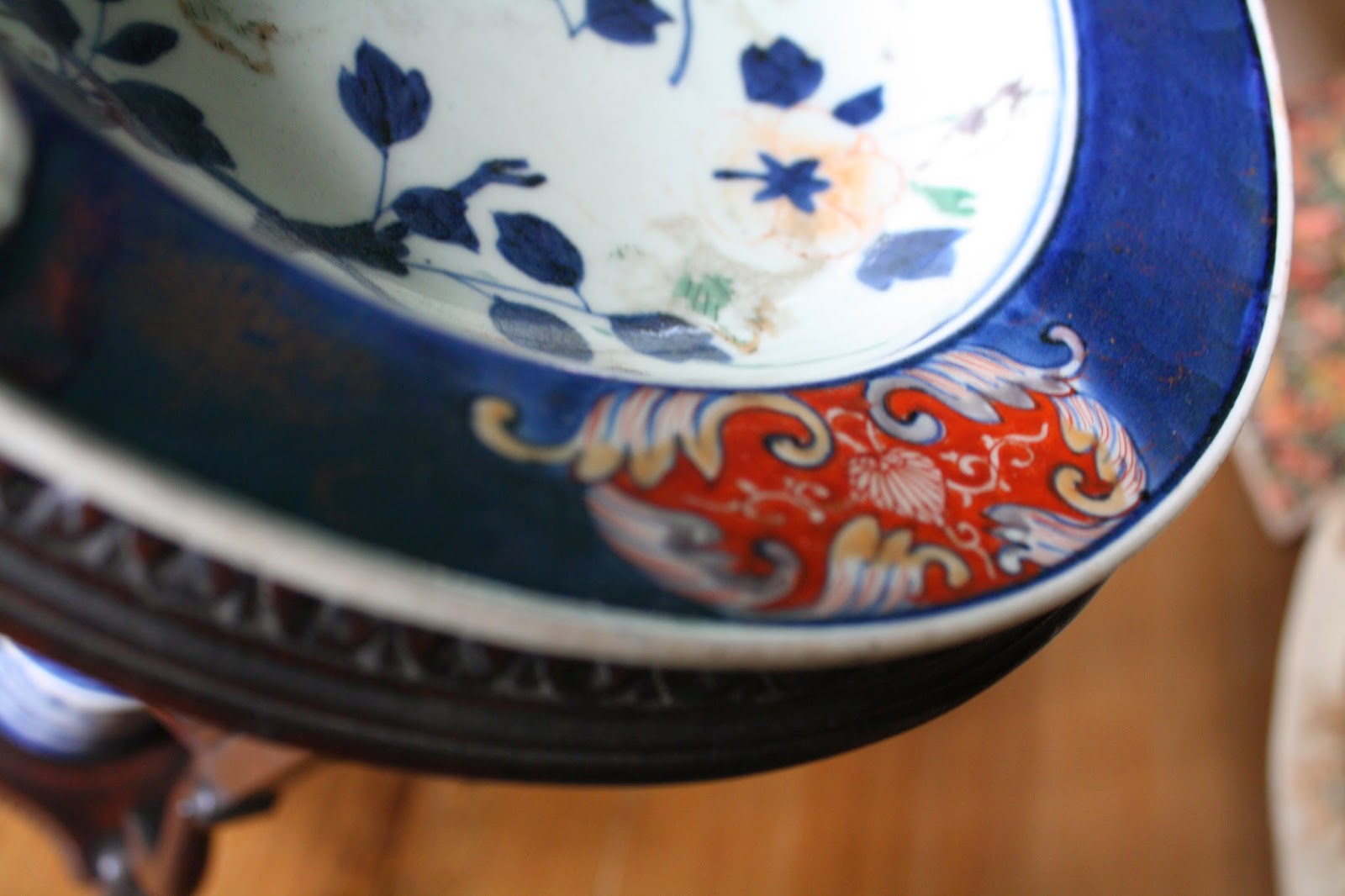
Resting on the top of our washstand is a Japanese Imari style shaving bowl of  the mid-eighteenth century. A shaving bowl can be identified by the notch cut out along the rim of the bowl so as to be placed at the throat of a gentlemen, just under the chin, to catch the removed facial hair and lather. Beards and facial hair in general were un-fashionable for the eighteenth-century gentleman and remained so until the mid-nineteenth century. According to a contemporary “the man of letters was clean shaven.”  


One of the shaving tools found in George Washington’s possessions was a whetstone, which was used to sharpen a razor so that it would not become dull.  Razors and other shaving implements were readily accessible to buy during the mid- to late-18th century. Wallace, Davidson, and Johnson, a mercantile firm formed in 1771, in their first year showed an order that included three and half dozen razors of various grades ranging from “common” to more costly “cast steel” types.  To facilitate shaving, a shaving brush, which was introduced in the mid-18th century, was used to apply lather to the face.  Washington owned one which is described as “appear[ing] to be made of badger bristles.”


John Mason, son of American statesmen George Mason, wrote that his father “always shaved himself—and used to shave his whole head which was covered by the Wig twice a week...”  The Randolph gentleman would no doubt have been involved in this routine—their portraits showing them clean shaven and wigged. 

Further Reading:
Hurst, Ronald C. and Jonathan Prown. Southern Furniture 1680-1830: The Colonial
Williamsburg Collection. Colonial Williamsburg Foundation: Williamsburg, 1997.
          Withey, Alun, Dr. “Beards, Moustaches and Facial Hair in History”. 21 March 2014. 6                    March 2014.
<http://dralun.wordpress.com/2012/04/26/beards-moustaches-and-facial-hair-in-history/>

“Wash Stand and Shaving Mirror”. The Cowper and Newton Museum. 6 March 2014.
           <http://www.cowperandnewtonmuseum.org.uk/collection/wash-stand-and-shaving-mirror>

“Architecturally Speaking: Room Use Study: Recommended Objects: Personal”. Gunston Hall
Plantation. 6 March 2014.
<http://www.gunstonhall.org/mansion/room_use_study/personal.html>.

“Object Spotlight: Washington’s Shaving Gear”. George Washington Wired: A Mt.Vernon Site.
6 March 2014. < http://www.georgewashingtonwired.org/2011/08/08/object-spotlight-shaving-kit/>

Papenfuse et. al., Edward C. “Biographies WAL”.
A Biographical Dictionary of the Maryland
Legislature 1635-1789. Volume 426. pg.855. Archives of Maryland Online. 10 April 2014. <http://msa.maryland.gov/megafile/msa/speccol/sc2900/sc2908/000001/000426/html/am426--855.html>


Wednesday, April 23, 2014

Re-Thinking This Old House

Creative leaders in the museum, entertainment, architecture, and archaeology professions gathered at Wilton House Museum for a day of ideation and dialog on future museum interpretation and programming.  Inspired by our mission statement, strategic plan, and the findings of our recent paint analysis investigation, Chipstone Foundation sponsored this Idea Day to offer advice and suggest paths to relevancy.  Participants, Jon Prown, Carl Lounsburry, Sumpter Priddy, David Crank, Donna Harris, Franklin Vagnone, Mark Wenger, and Sylvia Yount offer advice and suggestions on ways to invigorate our museum interpretation and programming.

Experiences, theories, and concepts filled the day’s conversations.  It was particularly reassuring to find that Wilton is not alone in the struggle to remain relevant in its community.  Like so many other historic house museums, we are rethinking the standard house museum interpretation that was established over fifty years ago.  As the community around us continues to evolve, so must we.  To those ends, we opened our minds to what was offered throughout the day.

As Director of Education three concepts resonated with me: access to history, dialog with visitors, and questions over answers. Equipped with our mission statement, we are better poised to experiment with exhibitions and interpretations.  As museums are considered the leading repository for historical resources and research we are better prepared to provide a more complex understanding of our past.

All three of these concepts were experimented with at our new March re-enactment, Washington at Wilton.  Along with the modern carpets and stanchions, most of the historic chairs were removed from the Wilton's study and replaced with period reproductions so that visitors could sit in the room and converse with George Washington.  The response from visitors was overwhelmingly positive.


In addition to the changes made to the historic setting we also asked visitors to put themselves in the shoes of a small farmer on the eve of the Revolution and decide whether or not they would leave their farm to fight for liberty.  The dilemma of personal security versus the potential benefit for the greater good was brought up in the discussions with Washington and the other re-enactors.  With the pros and cons debated, visitors cast their votes as well as defined what liberty meant to them.  What was most surprising about the voting was that it was not overwhelmingly in favor of war with Britain.  Rather, the votes were evenly split between war and peace.

For the past month, Wilton's study has remained devoid of the obvious modern intrusions that were removed prior to His Excellency's visit.  With the reproduction furniture remaining in the room, visitors are invited to have a seat in one of the designated chairs when they enter the room.  By sitting in these chairs visitors are introduced to a new perspective of this historic space.  In setting the study in this manner and inviting visitors to engage in it, we have stepped away from the vignettes of a by-gone day and welcomed our audience into a more true representation of this space.


As we continue to experiment with this evolution in our interpretation visitors are welcome to add their voice to the conversation.  What is the future of the historic house museum?  How do we remain good stewards to our collections, create historically accurate settings, and increase visitation?  What do you want out of your experience?

Monday, March 31, 2014

Latest Acquisition

Thomas Sully
Portrait of Peyton Randolph (1778-1828)
Richmond, VA
1806
Object ID: 2014.1.1-2

Wilton House Museum announces the recent acquisition of a portrait of Governor Peyton Randolph, a dashing and romantic painting by American artist Thomas Sully. After centuries of private ownership the painting now joins other Randolph family portraits on display in Wilton House Museum. This acquisition enhances our collection, advances our interpretive story, and connects the Randolph family and Wilton collection to one of the more dramatic moments in Virginia’s history, the 1811 Richmond Theatre fire that claimed the lives of seventy-two people.

Peyton Randolph (1779-1828) is the son of Edmund Randolph and Elizabeth Nicholas. Edmund had a distinguished career as George Washington’s aide-de-camp, the first United States Attorney General, and seventh Governor of Virginia. Peyton had a respectable career in politics, but is best remembered for serving as Acting-Governor of Virginia following the death of Governor George William Smith in the Richmond Theatre fire on December 26, 1811.

As the senior member of the Council of State, Randolph acted as governor until January 3, 1812, when the House of Delegates was able to reconvene and elect a new governor. Later, Randolph was an official reporter for the Virginia Reports, which was the official court reporter of the Virginia Supreme Court, until his death in 1828.

Having studied the painting of miniatures in Charleston, South Carolina, Thomas Sully (1783 – 1871) joined his brother Lawrence in Richmond and opened an artist’s studio where from 1804 through 1806 he painted portraits of prominent Virginians such as Peyton Randolph. Moving from Richmond, Sully studied under portrait artist Gilbert Stuart before establishing his studio in Philadelphia where he continued to paint masterly portraits and dramatic scenes from literature and history. “Thomas Sully is one of nineteenth-century America’s most important artists, whose career began in the Commonwealth of Virginia. Very few of his early works have survived today, so it is why it is a red-letter day for Wilton to obtain a handsome portrait such as the portrayal of Mr. Randolph,” says Dr. William Keyse Rudolph, the Andrew W. Mellon Chief Curator and The Marie and Hugh Article Halff Curator of American Art at the San Antonio Museum of Art.  Dr. Rudolph is the curator of the first United States Sully retrospective exhibition in thirty years: Thomas Sully:  Painted Performances. Sully is best known for his portraits, especially those of George Washington, Thomas Jefferson, and the Marquis de Lafayette. Sully’s portrait of Andrew Jackson is represented on the twenty dollar bill.

Wednesday, February 26, 2014

All the Bells and Whistles

Object: Baby Rattle with Whistle and Coral Teether
Accession Number: 2006.0003


Children have had and played with toys for as long as people have made it a point to record it.  While this is true, according to Karin Calvert, author of Children in the House: The Material Culture of Early Childhood, 1600-1900, the purpose and appearance of their toys has changed over time in America.  Different time periods have had different ideas of what childhood play should look like.

The collection at Wilton House museum includes a silver and coral rattle and teether that dates from the late 18th or early 19th century.  It consists of a piece of red coral with an ornate silver handle surrounded by bells, and a whistle at the other end.  It has a maker’s mark which is made up of a lion’s passant, a queen’s head, the letter “X” or “K,” and an anchor.  This maker’s mark is evidence that the rattle was likely made in Birmingham, England.


In the 17th century, children were expected to be essentially small adults.  This was out of fear that a child would not develop into an adult unless they were pushed by the parents.  For example, American colonists did not want their children to crawl, as they believed crawling was animalistic and beneath the dignity of human beings.  Most of the furniture for children was designed to deter crawling and promote standing and walking.  In all respects, children were encouraged to “grow up” quickly.  The toys children played with during this time were those that encouraged them to be adults.  The items that were acceptable were those that would prepare children for activities of adulthood, such as using a gun, sewing, cooking, or using tools.  During the second half of the 18th century, children were given more freedom to be children.  American parents began to believe the development of children into adults was natural and would occur without the children being pushed.  Playtime became acceptable and valued as necessary for a healthy childhood.

The coral and silver rattle served several purposes.  In addition to being a handsome toy, keeping the child happy and entertained while their older siblings contributed to the household chores, it was also a teether, a magical charm to ward off evil spirits and disease, a financial investment as it was made of silver, and a statement regarding the parent’s prosperity and position.  Rattles like this may have been given as elaborate christening gifts.  They were one of the few toys of the time period made specifically for infants.  For this reason, bells and coral became an icon associated with infancy during the 18th and 19th centuries.

The coral provided a smooth surface for a child to relieve the discomfort associated with teething.  It was believed the coral protected children from disease.  Parents feared teething as much as they did the deadly diseases of the time, such as diphtheria.  Doctors warned parents that problems associated with teething could cause “fevers, cramps, palsies, rheumes and other infirmities.”  Additionally, teething troubles could lead to “falling-sickness, and sometimes death thereby.”  Coral was the most common object recommended by doctors to assist them with the process.  Parents also believed the rattle protected children from the evil eye and other evil spirits.

During the time period in which the coral and silver rattle was made, play was understood to be a necessary and beneficial activity for children.  While this is true, these rattles were not toys exclusively; they served other practical, superficial, and even supernatural purposes.  They provided the infant with a teething outlet, exhibited a family’s wealth and position, and allegedly warded off evil curses.  The combination of these purposes kept children as well as their parents happy.

Portrait of a Boy with a Coral Rattle


10-month-old Elizabeth Gilbert in 1839 of New England

This blog entry was written by Shari Davis, an undergraduate student at Virginia Commonwealth University studying history. An audio version of this blog entry can be found here.

Bibliography

Brown, Gillian. “Child’s Play.” In The American Child: A Cultural Studies Reader, edited by Caroline F. Levander and Carol J. Singley. New Brunswick: Rutgers University Press, 2003.

Calvert, Karin. Children in the House: The Material Culture of Early Childhood, 1600-1900. Northeastern University Press: Boston, 1992.

McManus, Jennifer, Julia Grover, Kim Surber, and Theresa Laufer. “Play and Material Culture.” Gettysburg : Gettysburg College. (Accessed Feb. 17, 2014), http://www3.gettysburg.edu/~tshannon/341/sites/Childhood/Play%20and%20Material%20Culture.htm.

"Nicholas Roosevelt: Rattle, whistle, and bells." The New York: Metropolitan Museum of Art, 2000. (Accessed Feb. 17, 2014), http://www.metmuseum.org/toah/works-of-art/47.70.

Robinson, David. “Babies, Balls, and Bull Roarers: Christmastime or Anytime, Kids Still Enjoy the Toys and Games Their Forebears Loved”. The Colonial Williamsburg Official History & Citizenship Site. (Accessed Feb. 17, 2014), http://www.history.org/Foundation/journal/Christmas04/toys.cfm.

Image Credit

http://www.historicnewengland.org/about-us/whats-new/from-the-mouths-of-babes

http://www.magnoliabox.com/tag/coral%20rattle