Wednesday, March 28, 2012

A Divine Drink


Object: Chocolate Pot
Accession #: 1995.0007
The chocolate pot was invented in the 17th century to serve the growing popularity of hot chocolate. The first chocolate pot recognized as such was made by George Garthorne in England in 1685.  John Coney, a silversmith out of Boston, Massachusetts, is accepted as the first to make chocolate pots in North America around 1701.  


A chocolate pot has a shorter spout than a coffee pot and does not have a filter.  Chocolate pots also have a hinged lid with a “removable finial” for a stirring rod.  It was necessary for the chocolate to be stirred before it was poured because hot chocolate was thickened with cocoa butter.  The stirring rod, called a moussoir in French and a molinet in English (for little moulin or mill), was rolled between the palms of the hands to stir the chocolate. The French deviced the pot to serve chocolate in and be able to keep stirring it while keeping it hot.

It is possible that Mrs. Randolph owned a chocolate pot like this one in Wilton’s collection today, which she used to serve chocolate to her guests. This chocolate pot is a hexagonal-shaped silver chocolate pot with a boxwood handle and inset George II coin. Unfortunately, as one historian notes “By the 1820's, a process introduced to remove the fat from cocoa made the drink less heavy and thereby rendered obsolete the special accouterments that gave chocolate pots their beauty.”

                                                                                                                                                 
                                      A Lady pouring Chocolate ('La Chocolatière')
                                                           Jean-Etienne Liotard, c. 1744


In a letter to King Charles I of Spain, explorer Hernán Cortes wrote that, “[this] divine drink...builds up resistance and fights fatigue. A cup of this precious drink permits a man to walk for a whole day without food.”  The Spanish explorer brought chocolate back from his encounter with the Aztec who used chocolate as both a food and currency.  Chocolate mixed with sugar was introduced in Spain 100 years before coffee and tea.  Originally, chocolate was a drink served cold, “thick enough to hold up a spoon.”  It was the Spanish who came up with the idea of serving chocolate hot.  Hot chocolate spread to the rest of Europe when Maria Teresa (former Spanish princess), wife of Louis XIV, acquainted her court with it in 1660.  Chocolate grew in popularity because “to courtiers it was a symbol of chic” and “the drink [was] often figured in the era’s depiction of elegance.”  Thomas Jefferson predicted, “The superiority of chocolate, both for health and nourishment, will soon give it the same preference over tea and coffee in America which it has in Spain.”  The year 1755 is believed to be when chocolate arrived in the colonies because that was when colonists began to go into the chocolate business for themselves.


Chocolate was sold in the form of blocks, sticks, small rolls, or cakes wrapped in paper.  These blocks or sticks were ground to powder and added to the chocolate pot with hot water.  The moussoir or molinet was used to froth the chocolate which sometimes had spices added to it such as anise seed, pepper, ambergris, and cinnamon.  Elizabeth Raffald, an English businesswoman and author, wrote in her book The Experienced English Housekeeper in 1769 on how to make hot chocolate,  "Scrape four ounces of chocolate and pour a quart of boiling water upon it, mill it well with a chocolate mill, and sweeten it to your taste, give it a boil and let it stand all night, then mill it again very well, boil it two minutes, then mill it till it will leave a froth upon the top of your cups."


Chocolate was not just commended for its ability to satisfy one’s sweet tooth but also was seen as good for one’s health.  People drank chocolate as a medicine, known as a “confection.”  An English physician stated in 1662 that made up chocolate blends that could be taken as medicine and one ounce of chocolate had more fat and nourishment than a pound of meat.  Another physician from Holland, Amsterdam wrote, “Chocolate is not only pleasant of taste but is also veritable balm of the mouth, for the maintaining of the glands and humors in a good state of health.  Thus it is, that all who drink it, possess a sweet breath.”  In fact, it was a physician who began the giant chocolate industry of the United States.  It was Dr. James Baker of Dorchester, Massachusetts joined with chocolate maker John Hannon of Ireland in 1765 and sold chocolate.  Dr. Baker put up money to rent space in a gristmill where Hannon ground cocoa beans using water power.  A customer could buy their chocolate with cash or the factory would make it out of the customer’s cocoa beans.


                    Advertisment for Dr. Baker's              The Chocolate Girl
                    chocolate                                           Jean Etienne Liotard, c. 1743-1745


However, not everyone could afford chocolate.  One historian agrees, “Chocolate, always expensive, was taken at breakfast by fashionable society.”  The Chocolate Girl was done by Swiss artist Jean Etienne Liotard who had a chambermaid bring his morning chocolate and, impressed by her beauty, had the young lady pose for this painting.  The chocolate houses which opened in London in the 17th century never took hold in America, but as one historian states, “the leisured classes in Virginia took their chocolate at home.”   So it would not be at all surprising if as a guest of Mrs. Randolph, you might have been offered this “divine drink” which she would have served in a chocolate pot much like this one.

Bibliography
Bardi, Carla and Claire Peterson. The Golden Book of Chocolate: Over 300 great recipes.
            Barrons Educational Series, Inc. New York, 2008.
Deitz, B Paula. “Antigues; Chocolate pots brewed ingenuity”. NY Times on the Web. 19
February 1989. 8 March 2012. <http://www.nytimes.com/1989/02/19/arts/antiques-
chocolate-pots-brewed-ingenuity.html?pagewanted=all&src=pm>
Morton, Marcia and Frederic. Chocolate: An Illustrated History. Crown Publishers, Inc. New      
            York, 1986.
Wees, Beth Carver. "Coffee, Tea, and Chocolate in Early Colonial America". In Heilbrunn  
Timeline of Art History. New York: The Metropolitan Museum of Art, 2000–. 8 March
2011.<http://www.metmuseum.org/toah/hd/coff/hd_coff.htm>
 “Chocolate Pots”. Gourmet Sleuth. 8 March 2012.
<http://www.gourmetsleuth.com/Articles/Unique-Cooking-Tools-641/chocolate-
pots.aspx>
“Primary Source of the Month: Chocolate Pots”. Colonial Williamsburg. 8 March 2012.
<http://www.history.org/history/teaching/enewsletter/volume9/jan11/primsource.cfm>
“Eighteenth Century Chocolate: Chocolate as a Drink”. The Confectioners Mill Preservation
Society. <http://www.theconfectionersmill.com/chocolatedrink.html>

Images Credit:
http://www.nationalgallery.org.uk/upload/img/liotard-lady-pouring-chocolate-la-chocolatiere-L928-fm.jpg
http://www.925-1000.com/forum/viewtopic.php?t=7802
http://en.wikipedia.org/wiki/File:Jean-%C3%89tienne_Liotard_001.jpg
http://www.kraftbrands.com/bakerschocolate/funfacts.aspx


Wednesday, February 29, 2012

Good Ol' Fashion Gaming

Item: Game Table
Accession # 1960.3.1

The elite class of colonial America would often hold dinner parties for friends, family, and colleagues.  After dinner was finished, the women would retire to the parlor to gossip and entertain themselves. Meanwhile, the men would remain at the dinner table to discuss business and politics over more drinks, before joining the ladies in the ladies in the parlor.  At that point everyone would take part in the afternoon entertainments, which often included gaming or gambling.  Such gaming would take place at any one of the gaming tables the family may own.

The game table in Wilton’s collection is an English Queen Anne Triple Top Game Table.  This mahogany game table was beautifully crafted with elegant detail, most likely by a skilled cabinet maker, between 1725 and 1750.  The table has two playing surfaces: a solid mahogany surface and a red felt surface with carved square corners. The square corners are there to place candle holders for games being played during the night.   The red felt surface can been seen on the gaming table today.  The design of gaming tables has changed very little between the early eighteenth century and the mid eighteenth century.


Once the Randolph men and their male guests finished their drinks and discussion they would head to the game table to talk about their business dealings and any other issues that would have come up.  Not only would they talk about business, but they would also engage in friendly gambling. In the 1700s and on, card playing was a desirable social skill.  Games such as backgammon, chess, and checkers could be played on the solid mahogany surface, where as traditional card games such as whisk, poker, and all-fours would be played on the red felt surface.  Whisk is a four person, plain-trick game played with a standard fifty-two card deck. Poker was another popular game being played.  It is also played with a standard fifty-two card deck.  Poker players did not have partners and could bet as much as they would dare. The game All-Fours was another popular game being played during this time.  It usually was a four person game with two sets of partners, played with a fifty-two card deck.  The men typically gambled their slaves, money, horses, and parts of their plantations.  Many of these men gained and lost portions of fortunes and property while playing these game.  This game table provided an escape from the everyday worries of plantation life and is where a man could sit to have a good time with friends and strangers alike,

Bibliography:
http://www.furniturestyles.net/european/english/qu-card-tables.html
http://www.pagat.com/whist/whist.html
http://www.pagat.com/allfours/allfours.html
http://www.pagat.com/poker/history.html

Wednesday, February 15, 2012

Keeping Time


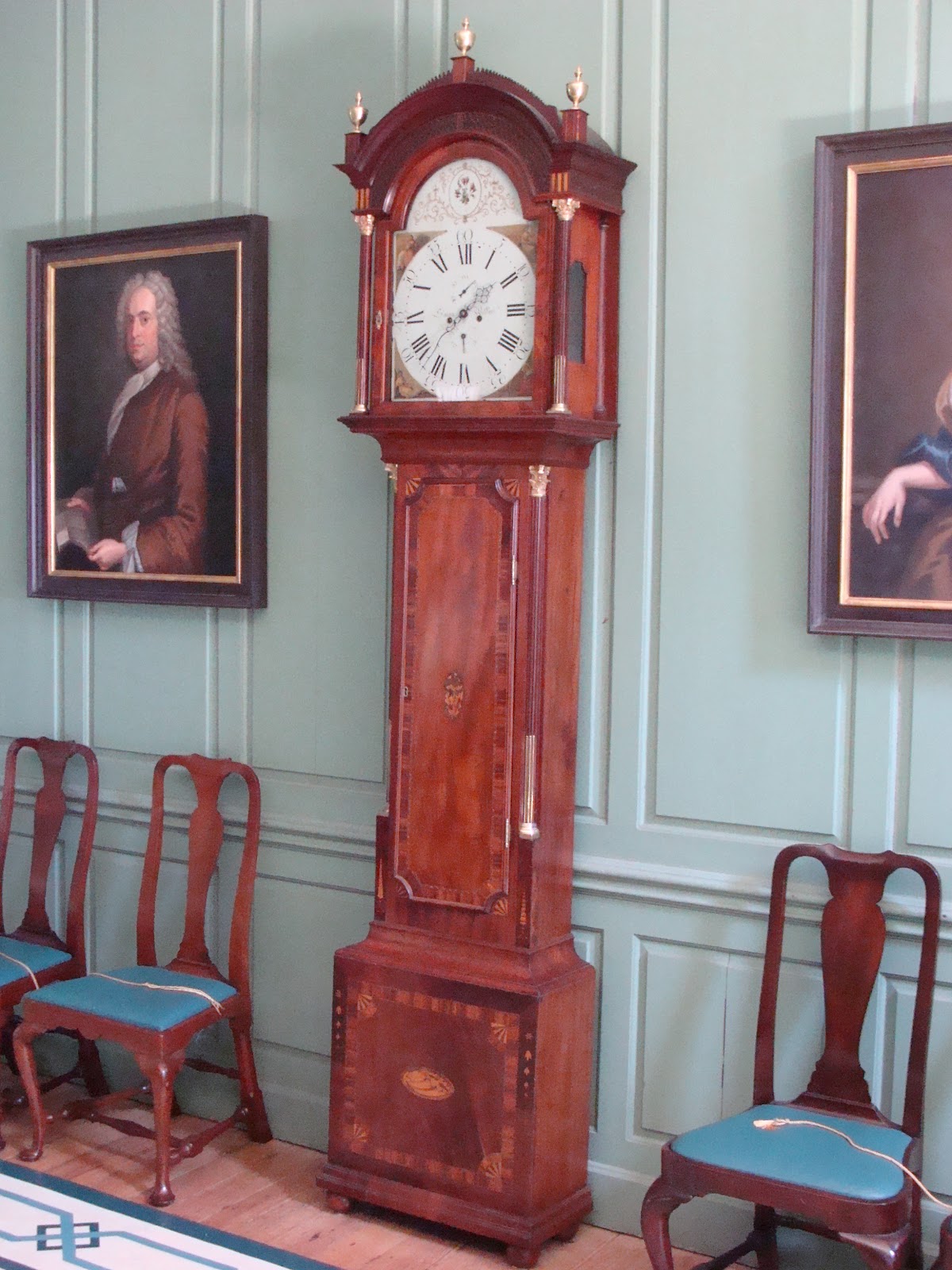
Object: Tall Case Clock, c. 1795-1810
Ascension #: 1937.0001

     Furniture is what defines a room and there is no piece of furniture that makes its presence known more than a clock. According to one historian writing on the subject of clocks, “unlike other antiques, the clock is peculiarly alive—its friendly face, peaceful tick and faithful record of hours over generations of time and creates a bond between past and present”.  This Federal Tall Case Clock made by Simon Willard of Roxbury, Massachusetts stands a majestic 8.5 feet tall in the lower passage of the Wilton House. The Randolphs may have owned a clock similar to this.  If so it would have had a prominence in the house such as where this one does today.  As denoted by another historian, “if ever something could be defined as the focal point of an entire house—circa 1800… is chances are it would be a tall case clock.”

     This clock is ornate from top to bottom—its arched hood with three plinths or chimneys on which rests brass half dome finials, carved fretwork, and saw toothed decoration flanked by stop-fluted brass mounted columns with brass Corinthian capitals. The face of the clock has a white painted dial with calendar, date and second registers, centering the painted inscription “Simon Willard”. The spandrels on the face have female figures representing the seasons and at the top of the face there is purple painted flora. The clock face is behind a glass wooden framed door. In addition, this part of the clock has a glass window on each side through which can be seen the clock’s gears and other moving parts. The trunk or middle of the clock has a pendulum door with a bellflower and fan inlay, and is also flanked with columns having Corinthian capitals. The base panel has a central leaf with a beetle peeking coyly from beneath the leaves. The whole clock rests on ball feet and is made out of a variety of woods including mahogany, boxwood, cherry, tropical hardwood, and white pine.


     Its maker, Simon Willard, was born on his family’s farm in Grafton, Massachusetts. It was there that his eldest brother Benjamin built a workshop next to the house. It is thought this is where he taught his younger brothers, including Simon, the art of making timepieces and the science of measuring time, known as horology. Simon eventually opened his own clock business in Grafton. There he experimented to reduce the size of the timepieces that drove the clocks. Later he opened a workshop on Boston’s Roxbury St.  Simon and his brother Aaron, who also owned a workshop in the same neighborhood, got the parts and materials needed for their clock making businesses from nearby factories.  English suppliers were also a source for the materials used by Simon and his brother because the vital raw materials like brass were lacking in the early United States. Entire clock mechanisms were put into the mahogany clock cases made in Boston. One historian notes, “The clocks of Boston became a sign of status” due to their quality. 

     Simon Willard boasted on labels affixed on the inside of some of his clocks “These clocks are made in the best manner. They run for a year and they don’t wind up. We will give evidence that it’s much cheaper to buy new clocks than to buy old or second hand clocks. Simon Willard warrants all his clocks.”  Not only that, but Willard’s opinion according to one historian was that the clocks he made “had to be just so expensive that, after acquiring one, the people may be still able to furnish their fine homes”. His clocks were highly valued, especially for their precision, because he had “trained hands and a great eye, filling cogwheels without using marks”.  After 1802, Simon Willard only produced tall case clocks also known as long case clocks, by special commission. Willard clocks such as the one located at Wilton are examples of the Hepplewhite style which have inlay work and are more delicate in design than the Chippendale style.

     Clock-making in America first developed in Massachusetts and Pennsylvania, and then later in Connecticut, which became the birth place of mass produced clocks in about 1840. The earliest clocks produced were wall or hang-up clocks which had all of the clock movements, weights, and pendulums exposed.  The change to a tall case clock occurred in England from 1670-1700.  A hood was added to protect the clock movements and a case to hide the pendulums and weights. The inside of these tall case clocks were cable driven, with the weights being suspended by cables wrapped around a pulley mounted to the top of each weight.  Movements of Tall case clocks were mainly made of brass and ran for eight days.  These were lubricated with bacon grease and may have provided the origin of the children’s rhyme “hickory dickory dock, the mouse ran up the clock”.

     Three people were involved in the making of the clock: clockmaker who took care of the internal workings of the clock, cabinet maker who made the case, and artist who decorated the dial. There are many cases that were made by cabinet-maker Stephen Badlam for the Willard Brothers. This clock’s case may be one of them as Badlam owned a shop in Dorchester, Massachusetts.  A distinctive feature of Badlam cases are the way the pendulum doors are cut. The corners of the door are cut away and are highlighted with fan inlays.  Bedlam cases had fretwork not only on top, but frequently featured blind fretwork above the dial doors as well.

     Due to the labor and craftsmanship that went into making tall case clocks, they were considered luxury items often the most expensive object that could be found in a late 18th to 19th century home. The Randolphs were in the top 2% of the population due to their wealth and social status. There is no doubt that they could afford to own a tall-case clock similar to this Simon Willard clock whose distinctive character cannot be fully appreciated unless seen in person, which is dally at the top of the hour when its melodic chime strikes the hour.


Bibliography
Distin, William H. and Robert Bishop. The American Clock: A Comprehensive Pictorial Survey
            1723-1900 with a listing of 6,153 clockmakers. Bonanza Books. New York, 1976.

“Simon Willard Clocks”. Wikipedia. 8 February 2012.  
            <http://en.wikipedia.org/wiki/Simon_Willard_clocks>

“Tall Case Clock Terminology” Gary R. Sullivan’s Antiques Inc.
            <http://www.garysullivanantiques.com/Research/TallCaseClockTerminology.aspx#LiveTooltip[7]>

Chiarello, Leslie. “The Tall-Case Clock”.  11 August 2010. Dumbartonhouse.org. 8 February 2012.
            < www.dumbartonhouse.org/pdfs/Tall-case-clock-show.pdf>

“Horology” Dictionary.com. 8 February 2012.  <http://dictionary.reference.com/browse/horology>

“Thread: Grand Wilton Simon Willard Tall Case”. National Association of Watch and Clock
Collectors, Inc. 8 February 2012. <http://mb.nawcc.org/showthread.php?78320-Grand-wilton-simon-willard-tall-case/page2>


Wednesday, February 1, 2012

The Language of the Fan

Object: Fan, 19th century
Accession # 1989.0022


Are you looking forward to Wilton’s exhibit on love and courtship since the eighteenth-century? To peak your interest, this week’s object from the collection is a finely carved, ivory Chinoiserie fan. Chinoiserie [sheen-wah-zuh-ree] is a French term used to describe European objects that reflect Chinese artistic themes. This fan is decorated with paintings of Oriental scenes and animals and carvings of birds, vines, and flowers. Although this fan was made in the nineteenth century, its style reflects a trend that first became wildly popular two centuries prior.

During the seventeenth century, fans became popular all over Europe as a women’s accessory; however, they were expensive and considered a high status, exotic item. Like highly valued porcelain, these fans were imported from the East.


The fad for fans only increased in the eighteenth century.  These fans, imported to Great Britain from China by the East India Company, reflect the modes of trade and fashion at the time. What was once exotic and rare in the seventeenth century became a widely produced commodity for wealthy, fashionable women. Like Chinese export porcelain and more economical British Wedgewood ceramics, the finest fans were made of ivory and less expensive versions were constructed of bone.  Surviving examples demonstrate a variety of decorative themes from the earlier mentioned Chinoiserie to painted scenes from Greek mythology and current events.  A well educated woman could use her fan as an invitation to discuss Virgil’s Aeneid or the British victory at the Battle of Porto Bello.

In the nineteenth century, the French fan maker Jean-Pierre Duvelleroy once again fueled the fashion for fans when he was appointed supplier for Queen Victoria. His London fashion house published a pamphlet instructing ladies in the “Language of the Fan.” For instance , the fan held in front of the face meant “Follow Me”, or  the fan in front of the ear told a suitor to ”Go away.” Although  there are no primary sources  referencing  a coded “language of the fan”  before this brilliant marketing ploy that does not mean that women  across the centuries did not wield their fans with a purpose beyond cooling themselves on a warm afternoon or in a crowded ballroom. Madame de Staël, the late eighteenth-century author and influential woman of her time, had the following to say about fans:

What graces does not a fan place at a woman’s disposal if she only knows how to use it properly! It waves, it flutters, it closes, it expands, it is raised or lowered according to circumstances. Oh! I will wager that in all the paraphernalia of the loveliest and best-dressed women in the world, there is no ornament with which she can produce so great an effect.


The fan from Wilton’s collection is monogrammed with the initials “GBD.” How do you think this lady flourished her fine fan?


Bibliography

Baumgarten, Linda,  What Clothes Reveal: The Language of Clothing in Colonial and Federal America.  The Colonial Williamsburg Foundation, 2002.

The Colonial Williamsburg Foundation, “Colonial Williamsburg ‘s Museum Collection of Historic Threads: Three Centuries of  Clothing. “ Online Exhibit, 19 January 2012.                     < http://www.history.org/history/museums/clothingexhibit/index.cfm>


Tea in a Teacup, “The Language of the Fan: Myth or Fact?.”  2 July 2011. 19 January 2012. <http://teainateacup.wordpress.com/2011/07/02/the-language-of-the-fan-myth-or-fact>


Also see: The Fan Museum, Greenwich, http://www.thefanmuseum.org.uk/


Image credits:


http://www.history.org/history/museums/clothingexhibit/museum_accessories.cfm?section=femaleacc#7: CW Fan 1740-1775; China for export to west, Ivory, painted paper, metal and paste rivet


http://www.nmm.ac.uk/blogs/collections/2011/01/the_navy_and_the_nation_in_the.html: battle of porto bello

Wednesday, January 18, 2012

A Place For Your Pills


Accession # 1901.0002
Item: Object: Pill Box
This small pill box, only .5 inches tall and just under an inch wide, is made of blue and black enamel. On the lid is written “Let your love like mine be lasting”.  Mrs. Randolph may have used a pill box similar to this to hold home remedies of her own or pills bought at the apothecary if there was one nearby.

Drugs were so expensive in the 18th century that colonists looked to their own gardens for remedies. Mrs. Randolph provided the health care for the plantation. It was common for the mothers to provide such care where there were few doctors. Powdered compounds were held together with wax, in dry or wet form. Plants and herbs were ground into powder using a mortar and pestle. “Benefits” were plants used to prevent disease while “helps” were the ones that provided cures. Some herbs that may have been used include foxglove, sassafras, sweet basil, and digitalis. Some of the home remedies of the past have affected our medicine of the present. The inside bark of the Willow tree was chewed to lessen pain. It contains an ingredient that goes into modern aspirin tablets.

Pills are first seen being used in ancient Egyptian times, as documented on papyruses. These were made of bread dough, honey, or grease. Plant powders that may have included cinnamon, myrrh, or saffron were mixed with them by rolling the ingredients into balls. In the 18th century patented medicine that one could buy from the general store or apothecary contained secret ingredients. Some examples of brand names were “Scot’s Pills”, “Daffy’s Elixir”, “Dutch Drops”, and “Goddard Drops.” Some others are “Chase’s Kidney-Liver Pills” and “William’s Pink Pills for Pale People (for the blood and nerves).” An apothecary could have used a pill tile to roll and divide pills. By 1700, drugs were tested and endorsed but not many of them worked. Some examples are: digitalis (the dried leaves of the purple foxglove) which was given for tuberculosis; iron salts for anemia; and Colchicum (a medical preparation made from the seeds or bulbs of the meadow saffron which had a solid bulblike rootstock and purple flowers) for rheumatic pains. Innovations in the 1800s included sugar or gelatin coating of pills.

The pill box is only big enough to fit maybe one or two pills. However, it would have fit well in the pocket of breeches or a petticoat more easily than a bottle and only a few pills are most times necessary to take.  If the pill box was a gift to the original owner, the message on the outside would bring to mind the giver of the box each time the bearer of it used it. Hopefully, it would make the consumption of the medication under the pleasant words much more endurable.


Bibliography

“Digitalis.” Def. 2  and “Colchicum.” Def. 3. Webster’s New Twentieth Century Dictionary, Unabridged. 2nd ed. 1979.

Mestel, Rosie.“The Colorful History of Pills can fill many a tablet.” LA Times on the Web. 25 March 2002. 19 November 2011. <articles.latimes.com/2002/mar/25/health/he-booster25>.

Silverman, Milton Morris. Pills, Profits, and Politics. Berkley: University of California Press, 1974.

Terkel, Susan Neiburg, Colonial American Medicine. New York: Franklin Watts, 1993.

Townsend, John. A Painful History of Medicine: Pills, Powders and Potions, A History of Medicine. Chicago: Raintree Publishing Company, 2006.

Wilbur, C. Keith. Revolutionary Medicine 1700-1800. 2nd ed. Connecticut: Globe Pequot Press, 1997.

Image Credits:
http://dovbock.com/Illustration_10_willow.html