Wednesday, June 13, 2012

To Clean and To Chill


Object: Wine Rinser
Accession #: 1904.0001


 As a guest for dinner at Wilton, one might have had their own wine rinser next to their dish during each course.  As one historian points out, “Glass rinsers were essential to genteel dining in the eighteenth century,” so it would have been for the Randolphs.  Dinner would have had a minimum of 3 courses and a different wine might have been served for each course. So a wine rinser would be placed around the table and filled with water, or even ice, for washing and chilling glasses between courses or wines.

This early 19th century clear, round glass wine rinser with a lip on each side has a continuous band of incised diamond filled cross hatching surmounted by a continuous band of oblique incised cuts.  It was common to see a wine rinser on the table in the 18th and 19th century at an elaborate dinner which might have had lemon water in it or water and ice essential during the hot months.
Before the second half of the 18th century a bowl was kept on the sideboard during dinner to rinse and chill glass between courses.  As one historian contends, “in the eighteenth century, wines were still preferred as cold as possible and the monteith continued to be used for cooling glasses.” However, in fashionable society, these large ornamental bowls, usually of silver, which suspended wine glasses from the notched rim, became obsolete.  This change in preference came after individual wine-glass-coolers, made of glass, were used at the coronation banquet of George III and Queen Charlotte in 1760. 

Alcohol was prescribed by doctors to ward off or cure many ailments.  Access to dependable sources of potable water was difficult, thus wine and other types of alcohol were seen as healthier to drink than water.  As one historian explains, “as in almost every Western nation, alcohol consumption was an intrinsic feature of social gatherings within all classes of American society.”  Foreign wines were purchased by those who could afford them, therefore it is likely that the Randolphs served wine from overseas to their guests.

Especially in the summertime, guests would have as preferred their wine cold.  According to archeological reports, the Randolphs did have an ice house.  An icehouse was common in larger homes in the 18th and 19th centuries and “most Virginia icehouses were brick lined and could be as large as fifteen feet in diameter and of a similar depth.”  The ice was collected in the winter time from large stretches of water and put in a chamber, often packed with straw.  The chamber could be built below the ground or into the side of a bank where the ice could be well insulated. The ice houses could sustain a cool temperature even through the grueling summer months when ice was needed for cooling and preservation.  One historian agrees, “Though not as efficient and convenient as our modern refrigerators, they did the job and kept fresh butter, milk, meats, and vegetables on the table, and, of course, ice for the after dinner drink.”
Dinner for the Randolphs was the most important meal of the day, especially when they had guests in attendance and would entertain them in the dining room.  The Randolphs would strive to impress their guests with a certain level of extravagance as well as comfort.  So it would not be surprising if each guest had a wine rinser to chill and clean their glasses between courses. As one historian puts it, indeed “the abundance of highly reflective cut glass would have added to the glittering effect of a dinner party,” which would please not only the guests but also the host and hostess.

.


Bibliography

Butler, Roy. “Early Ice Houses”. History. Library Point: Central Rappahannock Library. 24
March 2010. 18 May 2012. < http://history.librarypoint.org/early_ice_houses>
Egan, Heather. “Homewood House Museum Offers Lecture Series on the Art of Dining”. John
Hopkins Gazette on the Web. September 25, 2006. 17 May 2012.
<http://www.jhu.edu/~gazette/2006/25sep06/25hwood.html>
Hume, Audrey Noel. Food. Williamsburg: The Colonial Williamsburg Foundation, 1978.
Martin, L.G. “Petworth House Ice-House”. Petworth. 31 May 2009. 18 May 2012.
<http://www.icehouses.co.uk/petworth.htm>
McLeod, Stephen A., ed. Dining with the Washingtons. Mount Vernon: Mount Vernon Ladies’
            Association, 2011.
Williams, Sarah-Paston. The Art of Dining: a history of cooking and eating. London:  National
            Trust Entreprises Unlimited, 1993.
“Wine-Glass Cooler or Rinser”. Encyclo Online Encyclopedia. 31 May 2012. 17 May 2012.
<http://www.encyclo.co.uk/define/Wine-glass%20cooler%20or%20rinser>
“An Evening Card Party in Regency England” March 2003. 18 May 2012.
<http://www.georgianindex.net/cards/cardp.html>
“Monteith” Dictionary.com. 25 May 2012.
<http://dictionary.reference.com/browse/monteith?s=t>

Friday, June 1, 2012

A Divine Seat

Object: Bishop’s Folding Traveling Chair
c. 1750-1770

Accession #: 1998.0001

With most folding furniture constructed during the 18th century more emphasis is focused on how the chair works rather than the artistic or decorative arts aspects of the furniture.  Such emphasis may not have been the case with this particular folding chair.  This bishop’s chair is made of walnut with leather cushioned arms and seat.  The pierced splat is decoratively adorned with a lattice design and leaf motif.  Where the lattice work ends and meets at the top of the chair is an image of a cross.  Above the cross is the top rail, or crest rail, which has a row of fleur-de-leis bordered by a row of leaves, and the ears of the chair ripple out with carved ridges.  The chair has hinges on both sides to accommodate folding and carrying by the owner.

In the late 18th century, folding furniture was beginning to be made for travelling.  Some chairs referred to as “folding chairs” did not actually fold, but were taken apart when transported. Folding furniture dates back to the ancient Greeks who had a folding stool which had “X” shaped legs and a leather seat.  The owner’s status was reflected in the construction of these stools.  There is also evidence of folding furniture found in Egyptian tombs. 

The parlor of Wilton was where weddings, funerals, and christenings likely took place.  It is quite possible that the visiting clergy may have used a chair similar to this one while officiating at these events.  This type of chair may have evolved from the faldstool which was a portable chair stool that was taken with the bishop on his travels away from his own cathedral or place of worship.  The faldstool became a ceremonial chair taken with the bishop and may have been covered with silk.  It was used by most traveling clergy as early as the Middle Ages.  According to one historian, “The bishop's chair is called a cathedra from the Latin word for chair and it is the presence of the bishop's cathedra in a church that makes it a cathedral. The bishop's chair, then is a symbol of the bishop's teaching office and pastoral power in his diocese.”  The chair represented the authority to teach in ancient times. 

It was common for ministers to do extensive travelling outside of their own church buildings and also to make visits to homes.  In his book called Old Churches and Families of Virginia, Bishop Meade writes of a minister of the Bristol Parish in Dinwiddie County who “during his years of travelling, when he visited counties in North Carolina and Virginia,” was involved in “preaching in private homes.”  Also in George Wythe Munford’s The Two Parsons: Cupid’s sports; The dream; and the jewels of Virginia, Parson Buchanan is visited by a gentleman, “…announcing himself as Col. Robert Braintree, of the county of Mecklenburg.  After a few common-place remarks, he said, ‘I presume Mr. Buchanan, you have heard that I am about to be married to Miss Ingledon. I have called to request you to hold in readiness to perform the ceremony.  It is to take place on Thursday evening next, at her mother’s residence, at eight o’clock.’” As was the case with some weddings, funerals and christenings also took place in the home.  The Miss Ingledon mentioned by Munford is believed to be Miss Lucy Singleton, daughter of the late Captain Anthony Singleton and Lucy Harrison Singleton, widow of Peyton Randolph of Wilton.

Folding furniture was made for the convenience of travel.  A chair such as this was made for traveling clergy who presided over weddings, funerals, and christenings extending beyond the bounds of their own church walls and into such homes as Wilton. This chair and its counterparts were a symbol of the authority the clergy had who carried it along on his journeys. 

Bibliography
Aronson, Joseph. Encyclopedia of Furniture. 3rd rev. ed. New York: Crown Publishers Inc.,
1965.
Giblin, James Cross. Be Seated: A Book about Chairs. Harper Collins Publishers, 1993.
Meade, Bishop. Old Churches, Ministers, and Families of Virginia. 2 vols. Philadelphia:
Lippincott Company, 1906.
Munford, George Wythe. The Two Parsons, Cupid’s sport; the dream; and the jewels of Virginia.
Googlebooks.com. 7 May 2012. <http://books.google.com/books/about/The_two_parsons.html?id=D7ToA3qVifEC>
“Folding Chair”. Search the Collections. V&A. 2 May 2012.
“Faldstool”. Wikipedia. 18 April 2012. 2 May 2012. <http://en.wikipedia.org/wiki/Faldstool>
“Interesting Facts about Bishops”. Diocese of Orlando. 2 May 2012.
<http://www.orlandodiocese.org/en/about-the-diocese/history/facts-about-bishops>
“Folding chairs: Glastonbury Type”. Tim Bray. Albion Works. 15 March 2003. 2 May 2012.
“Faldstool-Bishop’s Chair”. Peter Leue Designer/Craftsman. 2 May 2012.
<http://www.peterleuedesignercraftsman.com/1980s/studio-furniture/9568839>
“Furniture Anatomy Illustrated”. Your Antique Furniture Guide. 2 May 2012. <http://www.efi-
costarica.com/furniture-anatomy.html>


Wednesday, April 25, 2012

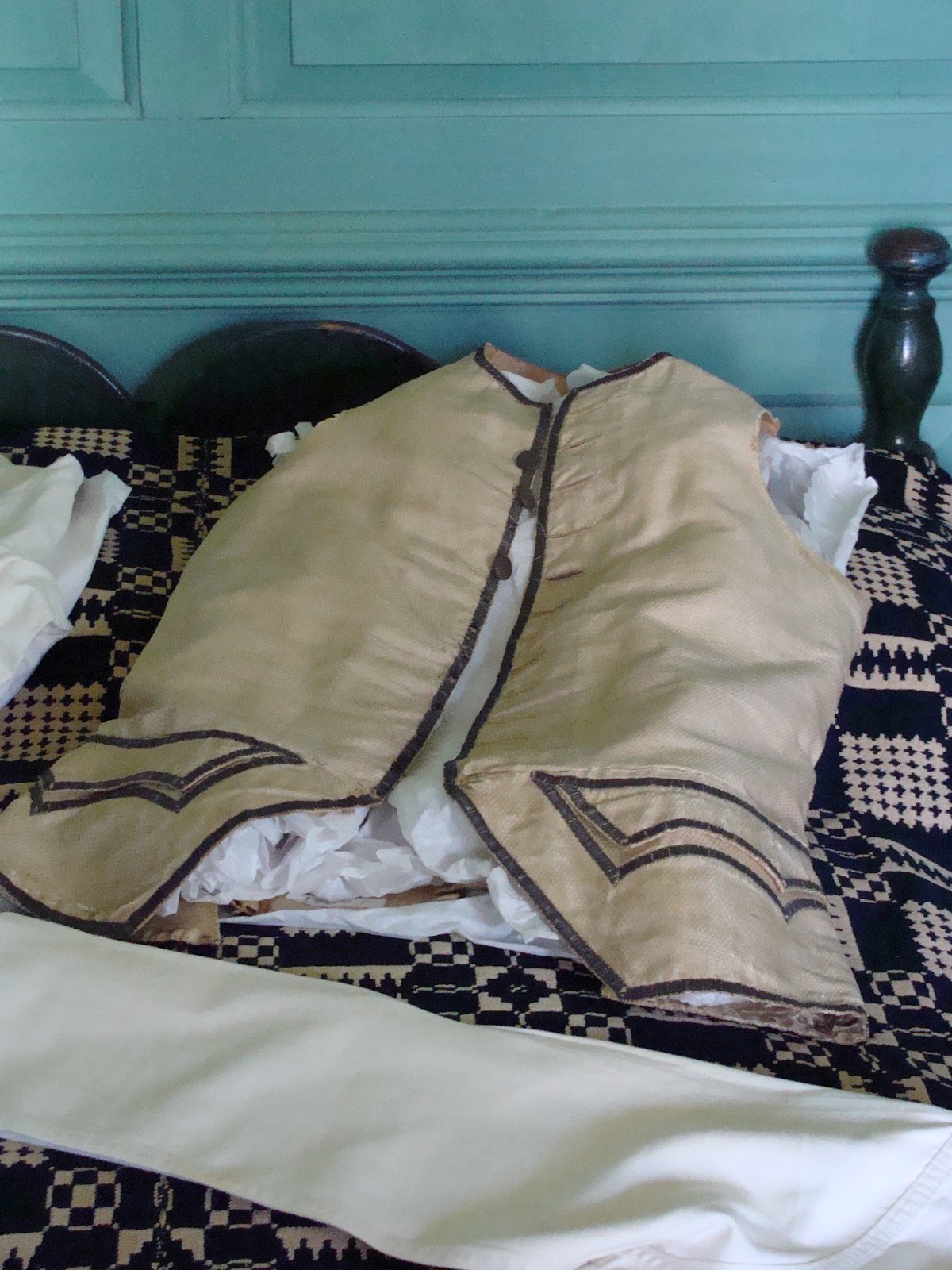
Dressed to Impress: Dr. Douglas’s Silk Waistcoat


Accession # 1989.0001
Item: Waistcoat
Men’s Clothing- Outerwear- Textile

Let your Address upon your first appearance be genteel and engaging, and consequently give advantageous impressions of you. - Lord Chesterfield: His Character and Characters by Colin Franklin

In British and European culture, men’s everyday and formal wear of the eighteenth century was defined by the three piece suit: coat, breeches, and waistcoat, a fashion that was developed from the court attire required by Charles II in 1666 after the British Restoration. Unless engaged in manual labor or relaxed in the privacy of one’s home, a coat worn over waistcoat and knee-length breeches was worn from season to season by all social classes. The material, intricacy of design, and tailoring distinguished the class of the wearer and the function of the suit. For grand occasions and royal court appearances no detail was spared on formal wear. Silk suits were embroidered with flowers and other decorative motifs. Commenting on men’s fashions and manners, Erasmus Jones noted, “A smart Coat, fine Waistcoat, nicely powder’d Wig, and lac’d Linnen, may in some degree justify a Man’s taking upon him in the Street, where Respect depends wholly upon Appearance.” From buckles on breeches to embroidery on waistcoats, each element revealed something of a man’s class, wealth, or expectations. Consider the painting of Henry Fane with Inigo Jones and Charles Blair by Sir Joshua Reynolds. Completed in 1766, each gentleman is portrayed, elegantly attired in a three piece suit.The waistcoat was as indispensable to everyday dress as the coat and breeches. On formal occasions, the waistcoat was often the most decorative element of the suit.

The silk waistcoat from the Wilton Collection has a particular connection to the Randolph family. A handwritten label attached to it reads, “COURT VEST. Over 150 years old. Worn by Dr. Douglas at the Court of George II. Mrs. J. W. Randolph.” Based on the life of Douglas and the style of the waistcoat, the label should read George III. Dr. Charles Douglas of Scotland was married to Susanna Randolph of Curles Plantation. According to Randolph family history, Susanna was born in Virginia, December 9, 1756, and raised in England. She married Douglas, a descendent of the illustrious Douglas clan and heir presumptive to the 14th Earl of Morton, on January 23, 1783. Shortly thereafter she was presented to George III at the Court of St. James in London. For such a grand occasion, fine and appropriate attire was a must; however, for men court attire was not necessarily à la mode.

©Victoria and Albert Museum, London
         The cut and fit of the three piece suit evolved over the course of the eighteenth century, but fashions from previous periods were often retained in court attire. A British waistcoat, c. 1770, from the Victoria and Albert Museum collection illustrates the flashiness of formal waistcoats. The fanciful embroidery, couched chenille thread and expensive satin silk conveyed wealth. Generally after the 1770s, waistcoats grew shorter, closer fitting, and less ornamented- embroidery was confined to the pockets, skirts and buttonholes. The formal Douglas waistcoat closely resembles those fashionable between the 1760s and 1770s.It lacks the highly decorative embroidery of other court suits. The front is made of beige silk with pewter gray braid sewn around the skirt and pockets. The skirt is cutaway in the shape of an inverted “V.” The waistcoat back and lining are linen. It was common to make the back of less expensive fabric. Perhaps as a physician, with plans to return to Virginia with his new wife, Douglas chose a sensible, but no less expensive, waistcoat to wear at court. The essayist and politician, Lord Chesterfield advised men to “dress yourself as well and as fine as the people of your age and rank do, in the place where you are. It is of more consequence to be well drest, than Philosophers are aware of…” Certainly Douglas’s waistcoat was chosen carefully to reflect his status; unfortunately we do not know what breeches or coat he wore.

        Not much is known about the private lives of Dr. Douglas and Susanna Randolph. What could his waistcoat and the rest of his wardrobe reveal about his character? In 1784, there is an account of Douglas and his wife at Wilton. After living in Virginia, possibly at Curles Plantation, Douglas moved to Bermuda where he died in 1823 and was buried at St. Peter’s Church in St. George’s. In his will, Douglas requested that Charles Randolph receive “Instruments Linen and cloaths apparel [apparel was a later notation] and the Seal of the Family. Perhaps the “cloaths apparel” included Douglas’s court waistcoat. The will is intriguing and signifies the importance and value placed on men’s clothing in the eighteenth century.


Bibliography

Costume Design Center. The Colonial Williamsburg Costume Handbook. Colonial Williamsburg
            Foundation, 2005.
“Historic Threads: Three Centuries of Clothing.” Colonial Williamsburg‘s online museum collection.
Colonial Williamsburg Foundation, 2012. 20 March 2012 <http://www.history.org/museums/clothingexhibit/index.cfm>.
 Jones, Erasmus, The Man of Manners, Third Edition, 1737.
Meade, Bishop William. Old Churches, Ministers and Families of Virginia. Philadelphia: J.B. Lippincott
 Company, 1906

For more information on eighteenth-century clothing search the collections on the Metropolitan Museum of Art and the Victoria and Albert Museum, London websites.

Image Credits
Painting of The Honorable Henry Fane (1739–1802) with Inigo Jones and Charles Blair by Sir
 Joshua Reynolds, 1761-1766, The Metropolitan Museum of Art, Accession
 Numbe:87.16 < http://www.metmuseum.org/collections/search-the-
            collections/110001900?img=0>
Waistcoat, Victoria and Albert Museum, London, Museum number: 652A-1898. <
< http://collections.vam.ac.uk/item/O90046/waistcoat/>

Wednesday, April 11, 2012

"I am a brazen-faced old optimist"

Object: Sundial
Ascension #: 2012.0003
The Randolphs may have had a sundial in their terraced gardens similar to this one to keep up with the fashionable garden décor of the times.  The bronze sundial’s face has Roman numerals to mark the morning and evening solar hours and Thomas Hart London 1765 inscribed on it.  Inside the Roman numerals that make up the outside ring are numerous scrolling leaf designs and Fleur de Leis along with a poem that reads in all caps:

Serene I stand amongst the flowers,
And only count life’s sunny hours,
For me dark days do not exist,
I am a brazen-faced old optimist.

Closing in on the center of the face is a small flower with feather-like leaves on either side around circle.  On the inside of this circle are the cardinal directions and between each letter is a cloud.  In the center of the face is the gnomon (Greek for 'pointer' or 'indicator', and also 'one who knows'), which casts the shadow, with numerous chased floral designs and a degree mark.  It is a horizontal sundial, which has the gnomon lined up with the tilt of the earth’s axis.  Horizontal sundials are typically the ones found on pedestals in gardens.  The gnomon makes an angle equal to the latitude of the location for which it was designed.  The angle of the gnomon is equal to the latitude of the original location for which the sundial was intended in this case possibly London, England.
The “shadow stick” is the earliest form of a sundial which was placed pointing up perpendicular to the earth and where it cast its shadow was marked.  Egypt and Mesopotamia had shadow measuring devices as early as 1500 B.C.  The Egyptians built obelisks or stone towers which helped people tell time as the shadow of the obelisk moved throughout the day.  The earliest description of a sundial comes from Berossus, a Babylonian priest and author in 300 B.C. Vitruvius writes in book 9 of his Ten Books on Architecture in about 25 B.C. a list of inventors and their various sundials in which he mentions Berossus “Berosus the Chaldaean is said to have invented the semicircular one carved out of a squared block and undercut to follow the earth's tilt.”  The first sundial was erected in Rome in the year 290 B.C.  Later, one historian explains that the Romans desired to have sundials put in “every possible corner of their villas and grounds”. Cicero makes a reference to his desire to have a sundial placed at his villa in a letter written in 48 B.C. to Tiro.  The earliest sundials in England of Saxon origins and may point to early Norseman dividing time into eight tides.

This sundial was presented in 1975 to Wilton by Lester Gayle, Jr. in memory of his wife who was a Dame for many years.  For more than thirty five years it had been casting the sun’s shadow on the house’s river side out in the elements because of the assumption that this timepiece was a 20th century reproduction of the original.  It was not until the prevailing winds of Hurricane Irene brought a oak tree down toppling the sundial from its stone pedestal to the ground leaving it bent and discolored due to contact with leaves and other organic material that a surprising discovery was made.  Upon investigation of the damaged sundial and to what extent it would need to be repaired, it was found that what had been basking in the sun for so many years was in fact not a 20th century reproduction, but an 18th century original done in 1765 by Thomas Hart of London.  Only two recorded sundials were made by Thomas Hart of London.  As one source notes, the rhyme was a 20th century addition as it suggests the word ‘optimist’ does not seem likely to have been used before this upon looking at the Oxford English Dictionary.  The sundial has since been repaired to its former glory.

One historian notes how timeless the sundial is, “Sundials continued to be erected long after clocks came into use, and in the 17th century many fine specimens were erected.  Clocks did not in any way diminish their popularity, and if the truth be known doubtless only helped to cause a greater number to be erected, since not only could they be relied upon to keep accurate time, but also to serve for the setting of a clock when it stopped.”  The custom of having bronze sundials mounted on stone pedestals on display in private gardens began as early as the late 17th century.  So as the Randolphs strolled through their garden on a sunny spring afternoon they could possibly have passed by a sundial such as this which helped them keep time as the hours of the day waned.

Come out during the 79th Historic Garden Week and experience being serene among the flowers and part of life’s sunny hours as you tour the gardens of many of Virginia’s historic landmarks. See www.vagardenweek.org for more details.

Bibliography
“Sundial History”. Accurate Sundials, LLC. 8 April 2012.                
         <http://www.accuratesundials.com/site/591582/page/143772>
“When Time Began: The History and Science of Sundials”. Time Center. 8 April 2012.            
         <http://www.timecenter.com/articles/when-time-began-the-history-and-science-of-sundials/>
“Sundial History”. www.sundials.net. 8 April 2012. <http://www.sundial.net/sundial-history.html>
“Sun Clocks” Journey in Time. 8 April 2012. <http://www.fi.edu/time/Journey/Sundials/aboutsd.htm>
“Antique Sundials and Weathered Modern”. Jardinique: Antique and Quality Garden Items. 21 March 2012.
         <http://www.jardinque.co.uk/garden_antiques/antique_sundials.htm>
“Types of Sundials” 10 April 2012. Sundials on the Internet.. 8 April 2012.
         <http://www.sundials.co.uk/types.htm>
 “Conservation Report”. Bronze et al, Ltd. 3 March 2012.
Mintz, Daniel. “History Topic: Timekeeping in the Ancient World: Sundials”. University of St.
            Andrews. April 2007. 8 April 2012.
            <http://www-history.mcs.stand.ac.uk/PrintHT/Sundials.html>
Nordoff, Helga. “History of the Sundial”. 8 April 2012.            
            <http://www.qwerty.co.za/sundials/intro/index.html>
Strohm, Bob. “Windfall at Wilton”.
Probst, Chuck. “Further to your sundial”. Email to Carol Givens. 8 October 2011.
Ward, John and Margaret Folkard. “Sundials: Part 2: Definitions and Basic Types”. Horticulture: 
       Royal New Zealand Institute of Horticulture. From The New Zealand Garden Journal (Journal of the
      Royal New Zealand Institute of Horticulture), Vol. 2, No. 1, March 1997, pp. 21-25. 8 April 2012.
     <http://www.rnzih.org.nz/pages/sundial2.htm>

Wednesday, March 28, 2012

A Divine Drink


Object: Chocolate Pot
Accession #: 1995.0007
The chocolate pot was invented in the 17th century to serve the growing popularity of hot chocolate. The first chocolate pot recognized as such was made by George Garthorne in England in 1685.  John Coney, a silversmith out of Boston, Massachusetts, is accepted as the first to make chocolate pots in North America around 1701.  


A chocolate pot has a shorter spout than a coffee pot and does not have a filter.  Chocolate pots also have a hinged lid with a “removable finial” for a stirring rod.  It was necessary for the chocolate to be stirred before it was poured because hot chocolate was thickened with cocoa butter.  The stirring rod, called a moussoir in French and a molinet in English (for little moulin or mill), was rolled between the palms of the hands to stir the chocolate. The French deviced the pot to serve chocolate in and be able to keep stirring it while keeping it hot.

It is possible that Mrs. Randolph owned a chocolate pot like this one in Wilton’s collection today, which she used to serve chocolate to her guests. This chocolate pot is a hexagonal-shaped silver chocolate pot with a boxwood handle and inset George II coin. Unfortunately, as one historian notes “By the 1820's, a process introduced to remove the fat from cocoa made the drink less heavy and thereby rendered obsolete the special accouterments that gave chocolate pots their beauty.”

                                                                                                                                                 
                                      A Lady pouring Chocolate ('La Chocolatière')
                                                           Jean-Etienne Liotard, c. 1744


In a letter to King Charles I of Spain, explorer Hernán Cortes wrote that, “[this] divine drink...builds up resistance and fights fatigue. A cup of this precious drink permits a man to walk for a whole day without food.”  The Spanish explorer brought chocolate back from his encounter with the Aztec who used chocolate as both a food and currency.  Chocolate mixed with sugar was introduced in Spain 100 years before coffee and tea.  Originally, chocolate was a drink served cold, “thick enough to hold up a spoon.”  It was the Spanish who came up with the idea of serving chocolate hot.  Hot chocolate spread to the rest of Europe when Maria Teresa (former Spanish princess), wife of Louis XIV, acquainted her court with it in 1660.  Chocolate grew in popularity because “to courtiers it was a symbol of chic” and “the drink [was] often figured in the era’s depiction of elegance.”  Thomas Jefferson predicted, “The superiority of chocolate, both for health and nourishment, will soon give it the same preference over tea and coffee in America which it has in Spain.”  The year 1755 is believed to be when chocolate arrived in the colonies because that was when colonists began to go into the chocolate business for themselves.


Chocolate was sold in the form of blocks, sticks, small rolls, or cakes wrapped in paper.  These blocks or sticks were ground to powder and added to the chocolate pot with hot water.  The moussoir or molinet was used to froth the chocolate which sometimes had spices added to it such as anise seed, pepper, ambergris, and cinnamon.  Elizabeth Raffald, an English businesswoman and author, wrote in her book The Experienced English Housekeeper in 1769 on how to make hot chocolate,  "Scrape four ounces of chocolate and pour a quart of boiling water upon it, mill it well with a chocolate mill, and sweeten it to your taste, give it a boil and let it stand all night, then mill it again very well, boil it two minutes, then mill it till it will leave a froth upon the top of your cups."


Chocolate was not just commended for its ability to satisfy one’s sweet tooth but also was seen as good for one’s health.  People drank chocolate as a medicine, known as a “confection.”  An English physician stated in 1662 that made up chocolate blends that could be taken as medicine and one ounce of chocolate had more fat and nourishment than a pound of meat.  Another physician from Holland, Amsterdam wrote, “Chocolate is not only pleasant of taste but is also veritable balm of the mouth, for the maintaining of the glands and humors in a good state of health.  Thus it is, that all who drink it, possess a sweet breath.”  In fact, it was a physician who began the giant chocolate industry of the United States.  It was Dr. James Baker of Dorchester, Massachusetts joined with chocolate maker John Hannon of Ireland in 1765 and sold chocolate.  Dr. Baker put up money to rent space in a gristmill where Hannon ground cocoa beans using water power.  A customer could buy their chocolate with cash or the factory would make it out of the customer’s cocoa beans.


                    Advertisment for Dr. Baker's              The Chocolate Girl
                    chocolate                                           Jean Etienne Liotard, c. 1743-1745


However, not everyone could afford chocolate.  One historian agrees, “Chocolate, always expensive, was taken at breakfast by fashionable society.”  The Chocolate Girl was done by Swiss artist Jean Etienne Liotard who had a chambermaid bring his morning chocolate and, impressed by her beauty, had the young lady pose for this painting.  The chocolate houses which opened in London in the 17th century never took hold in America, but as one historian states, “the leisured classes in Virginia took their chocolate at home.”   So it would not be at all surprising if as a guest of Mrs. Randolph, you might have been offered this “divine drink” which she would have served in a chocolate pot much like this one.

Bibliography
Bardi, Carla and Claire Peterson. The Golden Book of Chocolate: Over 300 great recipes.
            Barrons Educational Series, Inc. New York, 2008.
Deitz, B Paula. “Antigues; Chocolate pots brewed ingenuity”. NY Times on the Web. 19
February 1989. 8 March 2012. <http://www.nytimes.com/1989/02/19/arts/antiques-
chocolate-pots-brewed-ingenuity.html?pagewanted=all&src=pm>
Morton, Marcia and Frederic. Chocolate: An Illustrated History. Crown Publishers, Inc. New      
            York, 1986.
Wees, Beth Carver. "Coffee, Tea, and Chocolate in Early Colonial America". In Heilbrunn  
Timeline of Art History. New York: The Metropolitan Museum of Art, 2000–. 8 March
2011.<http://www.metmuseum.org/toah/hd/coff/hd_coff.htm>
 “Chocolate Pots”. Gourmet Sleuth. 8 March 2012.
<http://www.gourmetsleuth.com/Articles/Unique-Cooking-Tools-641/chocolate-
pots.aspx>
“Primary Source of the Month: Chocolate Pots”. Colonial Williamsburg. 8 March 2012.
<http://www.history.org/history/teaching/enewsletter/volume9/jan11/primsource.cfm>
“Eighteenth Century Chocolate: Chocolate as a Drink”. The Confectioners Mill Preservation
Society. <http://www.theconfectionersmill.com/chocolatedrink.html>

Images Credit:
http://www.nationalgallery.org.uk/upload/img/liotard-lady-pouring-chocolate-la-chocolatiere-L928-fm.jpg
http://www.925-1000.com/forum/viewtopic.php?t=7802
http://en.wikipedia.org/wiki/File:Jean-%C3%89tienne_Liotard_001.jpg
http://www.kraftbrands.com/bakerschocolate/funfacts.aspx