Showing posts with label 18th century. Show all posts

Thursday, January 2, 2014

Drink and be Merry

Object: Cellarette
Accession #: 1951.0013.0001 and 1970.0002      
During the 1700s and 1800s, affluent members of society acquired sophisticated and costly beverage accessories, including specialized furniture for storing drinking vessels. Cellarettes, or bottle chests, were made in fashionable designs and materials for dining rooms, parlors, or studies. They were both fashionable and practical, allowing the host to serve a wide assortment of wine and spirits from the comfort of the room.
            Traditionally, the cellarette was made of wood, often times mahogany, and with a hinged lid, that was frequently equipped with a lock.  The interior was often lined with metal or lead, and compartmentalized to hold up to twelve bottles or decanters.  They came in a variety of shapes and progressively grew taller, as did the wine bottles, in the 18th century. Common varieties were oval or rectangular with tapered or fluted legs on castors and were occasionally hooped with brass bands. Usually, they were kept under the centre of a sideboard or side table, and were rolled out for use. In some cases, the box portion of a cellarette could be detached from its base (you never knew when spirits would need to be hidden from unexpected guests).


Wilton has two contrasting cellarettes in the collection.  The first is a small mahogany English, George III hinged box from the late 18th century with brass lion head ring handles. Its interior is finished with four compartments, currently housing glass decanter bottles.  The set of 18th  century bottles share the qualities of rounded shoulders and a round glass stopper, as well as, being decorated with a gold leaf design consisting of flowers and leaves. Currently this cellarette is on display in the Randolph study. It makes more sense for this small piece to be used and portrayed there since it was more likely that of a personal collection of wines or spirits were kept for aside for the head of the house and his private guests while in that room, or for his own recreational use.
1970.0002


The second piece is a much grander cherry American, Federal style cellarette from the early 1800’s. The upper section is considered removable and also consists of a hinged lid with brass hardware.  The front has an inlay decoration of a stylized urn with leaves, while the stand is similarly inlaid on square tapering legs. The inlay’s consists of boxwood, ebony and rosewood on this piece. A larger, more elaborate cellarette such as this one, showcased in the Wilton dining room, displays the options of spirits to guests and made it’s  accessibility to guests quite easy.


American Decorative Arts Acquisitions . 81. Detroit Institute of Arts, 2007. 53-82. Web. < http://www.jstor.org/stable/23183095>. 

 Anderson, Jennifer. Mahogany: The Costs of Luxury in Early America. Harvard University Press, September 2012. 340. Web. <http://www.jstor.org/stable/j.ctt2jbszn>. 

Fletcher, Brigitte. "Trendy Wine Furniture." Antiques & Fine Art Magazine. <http://www.antiquesandfineart.com/articles/article.cfm?request=431>.

Wednesday, December 18, 2013

Pudding Cap

Object: Pudding Cap, Reproduction
Accession #: 2005.0042EC


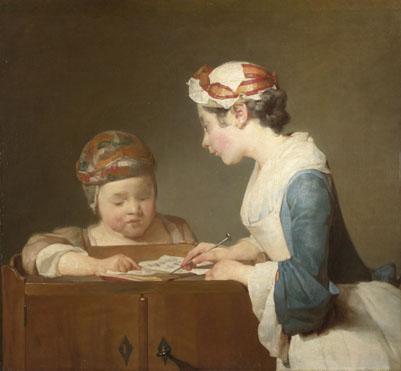
In the eighteenth-century children of both sexes were dressed similarly in petticoats and kept their hair long. Bibbed aprons were also popular. It can sometimes be difficult to determine if a child in a colonial portrait is a boy or a girl. Around the age of five a male child would be "breeched" and dressed in their first pair of breeches. 

A unique article of clothing specifically intended for toddlers learning to walk were pudding caps - padded helmets protecting them from injury due to accidental falls and bumps into furniture.

There are multiple theories to how the nickname of “pudding” came about.  One source from the UK states that the padded rolls showed a similarity to the shape and size of a sausage named black pudding, a popular food still enjoyed today.   A curator at Colonial Williamsburg claims the source of the name came from the caps “resemblance to the shape of pudding or pudding bowls.”


Regardless of where the name came from, many of the pudding caps shared a similar construction.  A simple cap was made of a horseshoe shaped roll that tied around the head in the back, typically with four triangular flaps that attached/ tied at the top of the head with ribbon. Horse hair and other materials were used for stuffing and padding the cap.   The ties in the back and at the top allowed for adjustments to accommodate a growing child’s head.  Many of the pudding caps were designed for everyday wear and tear; made out of dark fabric to disguise stains and dirt.   For a more grand styled pudding cap, leathers, silks and fur trims were frequently in fashion.

The reproduction pudding cap at Wilton is made of a combination of green velvet and leather, showcasing the prosperity of the family.  This item is currently on display in the nursery, where it would have been worn by one of the many Randolph children of Wilton.


Bibliography 
Baumgarten, Linda. What Clothes Reveal: The Language of Clothing in Colonial and Federal America : the Colonial Williamsburg Collection. Yale University Press, 2002. 160-167. eBook. 

"'Pudding' safety hat." Museum of Childhood. N.p.. Web. 24 Oct 2013. <http://www.museumofchildhood.org.uk/collections/clothing/pudding-safety-hat/>. 
Image Credit 
Chardin, Jean-Siméon. The Young Schoolmistress. 1735. Painting. The National Gallery, Trafalgar Square, London. Web. 24 Oct 2013. <http://www.nationalgallery.org.uk/paintings/jean-simeon-chardin-the-young-schoolmistress>. 
          Wilton House Museum 
 

Thursday, October 24, 2013

The Dumbwaiter Serves as a Genius Idea

Object name: Serving Table, or Dumbwaiter
Object ID: 1900.27

The dining experience at Wilton ranged from practical, everyday meals, to large dinner parties or celebrations.  In the mid -eighteenth century, having a specific place for such an occurrence was considered an absolute necessity in every prominent, fashionable house.  Since the dining room is the second most elaborate room at Wilton, after the parlor, it was customary to hold dinners for visiting guests in this space.


Breakfast was an informal meal and typically occurred between seven and ten o’clock in the morning. The buffet style meal consisted of rolls, biscuits, cold meats, coffees, teas, and chocolate.  Dinner was a much more formal meal; typically occurring between two and four o’clock in the afternoon. The meal could last hours and up to several courses could be served, including dishes such as meats, fish, vegetables, fruits, pies, rolls and wines.

Since kitchens were considered to be fire hazards and an annoyance, due to odors from supplies and trash, their locations were characteristically set away from the main house.  At the original location of Wilton, the prepared food was most likely brought through the basement door and into the warming kitchen until it was ready to be served in the dining room.  For dinners or formal occasions, Mrs. Randolph would have the slaves dress in all their finery to tend to the meal or have them wait in the nearby passageway to be called in for service.


Common dining room furnishings included large pieces such as a table and chairs to seat guests, to showcase the family’s fine china at place settings and display the courses for the meals. Sideboards and corner cupboards were kept in the room to store, display and protect the owners silver pieces and china. Smaller items, typical to this dining room, were items similar to looking glasses (mirrors), knife boxes and a dumbwaiter.


The dumbwaiter was used to hold the plates and dining fundamentals, as well as food or small platters of cheese and dessert throughout the duration of the meal. It could also hold the glasses and liquor bottles for later in the evenings, after meals have been completed.

Currently on display in the dining room, the mid-18th century, three tiered, mahogany dumbwaiter within the Wilton collection is a fine example of what the Randolph’s might have owned. The table, given as a gift from the Roanoke Committee, in honor of Mrs. Granville Gray Valentine, exhibits a central spiral, turned column and cabriole legs that end with pointed pad feet.  In the warm summer months, dining outside was not uncommon. The dumbwaiter made it easy for the food and drinks to be brought out and served.


 Bibliography
Wenger, Mark R. "The Dining Room in Early Virginia." Perspectives in Vernacular Architecture. 3. (1989): 149-159. Web. 24 Oct. 2013. <http://www.jstor.org/stable/3514301>.

 "Design and Decor - Convenience." Thomas Jefferson's Montecillo. N.p., n.d. Web. 24 Oct 2013. <http://www.monticello.org/site/jefferson/design-and-decor-convenience>. 

Image Credit
Wilton House Museum

Wednesday, September 11, 2013

An Element of Colonial Plantation Medicine

Object: Still
Accession #: 1951.10A-C


Recently featured on Antiques Roadshow's Facebook page, this 18th-century device was used for the distillation of spirits and medicinals. The copper body has two loops for lifting and a removable mushroom-shaped cap with an elongated spout. The person operating the still, usually the mistress of the house, would add the ingredients of her concoction to the body of the still and place it in its iron stand over a fire with the spout sticking out of the fire. The fire would boil the liquid in the base of the still and turn it into gas. This evaporated steam would collect in the top portion of the still and recondense into a liquid in the cooler spout portion, also called the "worm." The mistress would then collect the liquid that drips through the spout. This particular still originally came from Major Robert Beverly's plantation home, Blandfield. It is likely the "six gallon still and worm" Beverly ordered for the house in 1763. The large size of the fire required to heat this still suggests that it was used for spirits or in smaller quantities, medicine.


After the use of bloodletting and purgatives, medicinal or "physick" drinks were the next most popular colonial treatment for a variety of complaints. Due to the scarcity of doctors during this time in America, some medical knowledge was one of the expectations of colonial housewives. Jane Bolling Randolph, the mother of Ryland Randolph, was the author of a book of receipts (recipes) for both cooking and medicinal remedies known as the Commonplace Book. These remedies reflect a combination of herbal knowledge shared from Native American sources, superstition, the ancient European theory of disease arising from an imbalance of bodily humours, and some experimentation.

This simple recipe for the treatment of Whooping Cough comes from Every Man his own Doctor: or, The Poor Planter's Physician, written by Virginia practitioner John Tennant in 1734 [sic throughout]:
For this, boil Hysop and Elicampane, a Handful of each, in 2 Quarts of Water, strain it off, and adding 1 Pound of clean Muscovado Sugar, boil it again, and give the Patient 2 Spoonfuls every 3 hours.


Bibliography

Harbury, Katharine E. Colonial Virginia's Cooking Dynasty. University of South Carolina Press. Columbia, South Carolina: 2004.
Tennant, John. Every Man his own Doctor: or, The Poor Planter's Physician. Facsimile Edition by Printing and Post Office. Williamsburg, Virginia: 1984.

Image Credit