Wednesday, February 12, 2014

A Pinch of Snuff

Cowrie Shell Snuff Box
Accession Number: 1903.0002

What introduces Whig or Tory,
And reconciles them in their story,
When each is boasting in his glory?
A pinch of snuff.

Where speech and tongue together fail,
What helps old ladies in their tale,
And adds fresh canvas to their sail?
 A pinch of snuff.


            From the seventeenth century through the mid-nineteenth century, the consumption of snuff played an important role in the social lives of men and women. As implied by the preceding poem, snuff stimulated conversation at social gatherings or allowed for a point of contact for those of different backgrounds. An 1863 article in Harper’s Weekly claimed snuff was consumed to prevent infections and “amuse the vacant mind” in the presence of dull company. Snuff also created moments of surprise and cultural difference, such as the shock many eighteenth century northerners experienced when encountering elite southern women regularly using snuff.
Clearly it was an important part of colonial and early American life, but what is snuff? Snuff was made by curing tobacco leaves and then grinding the leaves by hand or with a mortar and pestle, a method initially adopted from Native Americans. With the wide variety of tobacco leaves available in colonial and early America, snuff came in a variety of types and flavors. For example, a common type of snuff called “Maroco” called for “forty parts of French or St. Omar tobacco with twenty parts of fermented Virginia stalks in the powder.” Usually a pinch of snuff was inhaled through the nose, sometimes as often as every hour.
Snuff users developed distinctive mannerisms and technologies associated with the production and intake of snuff. Of particular interest was the emergence of small, pocket-sized containers used for carrying snuff known as snuff boxes. These boxes were made of materials including shells, paper-mache, wood, and silver and were often decorated with engravings, portrait miniatures, or jewels. Snuffboxes functioned as an accessory for many men and women, therefore demonstrating their social class based on the materials used to construct the box or the beauty of the piece. Paper-mache boxes were common and less ornate, while boxes made of shells or jewels were more rare and associated with the upper class.

The collection at Wilton House Museum contains a mid-eighteenth century brown and white cowrie shell snuffbox with silver hinges and a silver bottom engraved with “E.T” in script. Although the original owner of the snuffbox is unknown, the Randolph family likely owned an object similar to the cowrie shell snuff box because of their great wealth. Cowrie shells were associated with womanhood, fertility, birth, and wealth. Since cowrie shells were only found in Africa and Asia, Europeans and American colonists typically acquired cowrie shells through their involvement with the West African slave trade. Cowrie shell snuff boxes were quite rare compared to other types of boxes and it is exciting, and unique, that Wilton has one in their collection!

This blog entry is by Caitlin Foltz, a graduate student at Virginia Commonwealth University studying 19th and 20th century American history.  Listen to the podcast version here.

Bibliography

Betts, Vicki. “The ‘Social Dip:’ Tobacco Use by Mid-19th Century Southern Women.” (Accessed Feb. 2, 2014), http://www.uttyler.edu/vbetts/snuff.htm.

“Cowrie Shell.” Thomas Jefferson Encyclopedia. (Accessed Feb. 7, 2014), http://www.monticello.org/site/research-and-collections/cowrie-shell.

Curtis, Mattoon M. The Book of Snuff and Snuff Boxes. (USA: Van Rees Press, 1935).

“You Say Six Reasons Are Enough.” Harpers Weekly. (Sept. 28, 1867, p. 619). 


Thursday, January 2, 2014

Drink and be Merry

Object: Cellarette
Accession #: 1951.0013.0001 and 1970.0002      
During the 1700s and 1800s, affluent members of society acquired sophisticated and costly beverage accessories, including specialized furniture for storing drinking vessels. Cellarettes, or bottle chests, were made in fashionable designs and materials for dining rooms, parlors, or studies. They were both fashionable and practical, allowing the host to serve a wide assortment of wine and spirits from the comfort of the room.
            Traditionally, the cellarette was made of wood, often times mahogany, and with a hinged lid, that was frequently equipped with a lock.  The interior was often lined with metal or lead, and compartmentalized to hold up to twelve bottles or decanters.  They came in a variety of shapes and progressively grew taller, as did the wine bottles, in the 18th century. Common varieties were oval or rectangular with tapered or fluted legs on castors and were occasionally hooped with brass bands. Usually, they were kept under the centre of a sideboard or side table, and were rolled out for use. In some cases, the box portion of a cellarette could be detached from its base (you never knew when spirits would need to be hidden from unexpected guests).


Wilton has two contrasting cellarettes in the collection.  The first is a small mahogany English, George III hinged box from the late 18th century with brass lion head ring handles. Its interior is finished with four compartments, currently housing glass decanter bottles.  The set of 18th  century bottles share the qualities of rounded shoulders and a round glass stopper, as well as, being decorated with a gold leaf design consisting of flowers and leaves. Currently this cellarette is on display in the Randolph study. It makes more sense for this small piece to be used and portrayed there since it was more likely that of a personal collection of wines or spirits were kept for aside for the head of the house and his private guests while in that room, or for his own recreational use.
1970.0002


The second piece is a much grander cherry American, Federal style cellarette from the early 1800’s. The upper section is considered removable and also consists of a hinged lid with brass hardware.  The front has an inlay decoration of a stylized urn with leaves, while the stand is similarly inlaid on square tapering legs. The inlay’s consists of boxwood, ebony and rosewood on this piece. A larger, more elaborate cellarette such as this one, showcased in the Wilton dining room, displays the options of spirits to guests and made it’s  accessibility to guests quite easy.


American Decorative Arts Acquisitions . 81. Detroit Institute of Arts, 2007. 53-82. Web. < http://www.jstor.org/stable/23183095>. 

 Anderson, Jennifer. Mahogany: The Costs of Luxury in Early America. Harvard University Press, September 2012. 340. Web. <http://www.jstor.org/stable/j.ctt2jbszn>. 

Fletcher, Brigitte. "Trendy Wine Furniture." Antiques & Fine Art Magazine. <http://www.antiquesandfineart.com/articles/article.cfm?request=431>.

Wednesday, December 18, 2013

Pudding Cap

Object: Pudding Cap, Reproduction
Accession #: 2005.0042EC


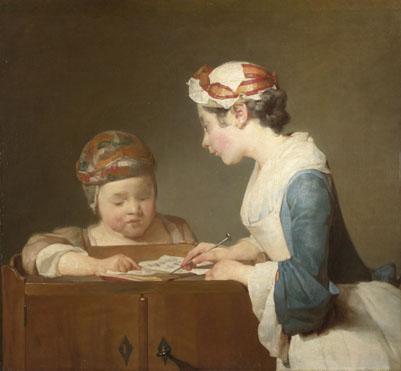
In the eighteenth-century children of both sexes were dressed similarly in petticoats and kept their hair long. Bibbed aprons were also popular. It can sometimes be difficult to determine if a child in a colonial portrait is a boy or a girl. Around the age of five a male child would be "breeched" and dressed in their first pair of breeches. 

A unique article of clothing specifically intended for toddlers learning to walk were pudding caps - padded helmets protecting them from injury due to accidental falls and bumps into furniture.

There are multiple theories to how the nickname of “pudding” came about.  One source from the UK states that the padded rolls showed a similarity to the shape and size of a sausage named black pudding, a popular food still enjoyed today.   A curator at Colonial Williamsburg claims the source of the name came from the caps “resemblance to the shape of pudding or pudding bowls.”


Regardless of where the name came from, many of the pudding caps shared a similar construction.  A simple cap was made of a horseshoe shaped roll that tied around the head in the back, typically with four triangular flaps that attached/ tied at the top of the head with ribbon. Horse hair and other materials were used for stuffing and padding the cap.   The ties in the back and at the top allowed for adjustments to accommodate a growing child’s head.  Many of the pudding caps were designed for everyday wear and tear; made out of dark fabric to disguise stains and dirt.   For a more grand styled pudding cap, leathers, silks and fur trims were frequently in fashion.

The reproduction pudding cap at Wilton is made of a combination of green velvet and leather, showcasing the prosperity of the family.  This item is currently on display in the nursery, where it would have been worn by one of the many Randolph children of Wilton.


Bibliography 
Baumgarten, Linda. What Clothes Reveal: The Language of Clothing in Colonial and Federal America : the Colonial Williamsburg Collection. Yale University Press, 2002. 160-167. eBook. 

"'Pudding' safety hat." Museum of Childhood. N.p.. Web. 24 Oct 2013. <http://www.museumofchildhood.org.uk/collections/clothing/pudding-safety-hat/>. 
Image Credit 
Chardin, Jean-Siméon. The Young Schoolmistress. 1735. Painting. The National Gallery, Trafalgar Square, London. Web. 24 Oct 2013. <http://www.nationalgallery.org.uk/paintings/jean-simeon-chardin-the-young-schoolmistress>. 
          Wilton House Museum 
 

Wednesday, December 4, 2013

Standing High


Object: Chest of Drawers,  c. 1740-1760

Accession #: 1909.0003

The Queen Anne period, according to one historian, was known for “its elegant simplicity achieved by beauty of the line.”  This mahogany high chest in Wilton’s collection was made in Massachusetts and gives is an example of a piece from this period. Much of the population and wealth of New England was concentrated in eastern Massachussetts, in and around Boston, and northeastward along the coast through Salem, Marblehead, and Ipswich. The high chest of drawers was introduced from England into Boston in the 18th century.


This high chest of drawers has many distinct features that point toward Marblehead as its possible place of origin. According to one historian, “No town in colonial America capable of supporting a cadre of furniture craftsmen has been less appreciated than Marblehead, and no Massachusetts town has a higher percentage of surviving pieces signed by its known cabinetmakers.”  This same historian brings out three distinct features of Marblehead high chests which are present in this one which stands in the master bedchamber of Wilton.  An incised semicircle at the perimeter of the fans points to Marblehead. In addition, the drawer bottoms’ grain runs from front to back which is “indicator of Marblehead work prior to 1780.” The historian, writing about Marblehead high chests, continues by pointing out that “virtually every piece documented or attributed to Marblehead has either widely spaced double beading or a single bead on the inside edge, with the former appearing just over half the time.” This high chest in Wilton’s collection has double beading. 


Though Wilton was constructed with eleven closets the Randolph family would have used chests of drawers for storage of household linens and clothing. Closets were used to the storing of household goods, not clothing, in the eighteenth-century. According to one historian, “the most commanding piece of furniture in a colonial American home was the high chest of drawers" testament to the owners taste and wealth. Not only could you afford such an elegant piece of furniture, but you had the wherewithal to fill its many drawers with costly garments and textiles. 

This particular high chest of drawers was donated to the Wilton collection by Jessie Dew Ball du Pont whose generosity continues to live on through the Jessie Ball du Pont Religious, Charitable and Educational Fund established in her will.


Bibliography
Lindquist, David P. The Big Book of Antique Furniture. Krause Publications. Iowa, 2002.
Obbard, John W. Early American Furniture: a guide to who, when, and where. Collector Books,
Inc. Paducah, 2006.
Widmer II, Kemble and Judy Anderson. “Furniture from Marblehead”. Antiques Magazine. May
2003.
Cheek, Mary Tyler Freeman and Ralph B. Draughon, Jr. “Who Was Jesse Dew Ball dupont?”. 
“High Chest of Drawers”. Decorative Arts Trust. 30 October 2013.


Tuesday, November 12, 2013

The Life of George Washington by John Marshall


Objects: The Life of Washington, Vol. I-V
Object ID: 1998.2.1-5

George Washington was not only considered a military and revolutionary hero, but a man of great personal integrity, duty, honor and patriotism. Known for his roles as the head of the Continental Army and as our nation’s first president; he helped create a legacy of strength and national purpose.
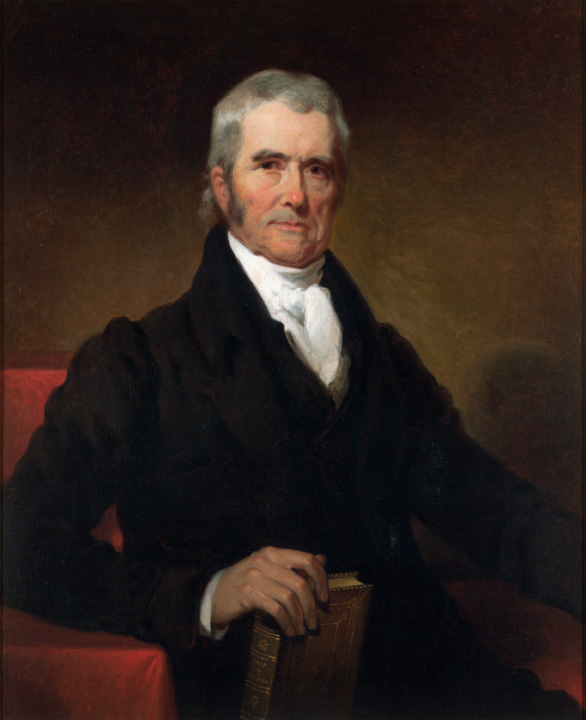
Upon Washington’s death in 1799, at the age of 67, his personal notes and files were left to his nephew, Bushrod Washington. As a friend of the first president, John Marshall announced Washington's death, offered the eulogy, chaired the committee that arranged the funeral and led the commission that planned a monument in the nation's capital. Washington had known Marshall's father, Thomas, through his early surveying career, and during a young Marshall's military service, he developed his own friendship with the commander-in-chief. Due to the close relationship that Marshall shared with George Washington, Bushrod asked Marshall to write the official biography for his uncle. Marshall began writing Washington’s biography in 1801 and continued to add to the manuscript for five years. The resulting biography resulted in five volumes totaling more than 3,200 pages of dates and dates of his personal, political and military life. 
            Born on September 24, 1755 to Thomas and Mary, John Marshall grew up in an adequately educated household that held significant social, religious and political status in Prince William County of Virginia (currently Fauquier County).  Marshall’s formal education began in 1767 from a traveling minister who lived in the household; providing Marshall with readings and teachings. John later went on to receive a more thorough education at the academy of Reverend Archibald Campbell. Marshall also did a six week study at William and Mary College in 1780 where he attended the law lectures of George Wythe.
           During his political activity in the late 1700’s, as Marshall’s private law practice flourished, he served in the House of Delegates and became the leader of the Federalist Party. During this time, Marshall managed to meet and marry Mary Ambler in 1783.  On January 20, 1801, President Adams nominated Marshall to be Chief Justice of the United States with the Senate unanimously confirming the nomination on January 27.  John Marshall was sworn in on February 4, 1801 and served as Chief Justice for thirty-four years.
            The five volume biography that John Marshall wrote is a prized addition to the Wilton library. Not only was Marshall a Randolph decedent of William I, but George Washington was considered to be a good friend of the family.  It was even reported that the Randolph’s entertained Washington at Wilton for three nights when Washington attended the Second Virginia Convention in 1775.

A first edition set of this Washington biography by Randolph family descendant John Marshall can be seen in our current museum exhibition: The Randolph Family Reunion November 2012 through February 2014.


Bibliography
Gordon, Douglas H. "John Marshall: The Fourth Chief Justice." American Bar Association Journal. 41.8 (1995): 698-702, 766-771. Print. <http://www.jstor.org/stable/25719292>.    

 Freidel, Frank, and Hugh Sidey. "The Presidential biographies ." The White House . White House Historical Association, n.d. Web. 24 Oct 2013. <http://www.whitehouse.gov/about/presidents/georgewashington>. 

"John Marshall." Library of Virginia. N.p., n.d. Web. 24 Oct 2013. <http://www.lva.virginia.gov/exhibits/marshall/>.

Image Credit
 http://www.whitehousemuseum.org/furnishings/george-washington-gilbert-stuart.jpg

 http://www.virginiamemory.com/docs/Marshall07_0978_ART027_02.jpg

 http://dyn1.heritagestatic.com/lf?set=path[7%2F6%2F4%2F4%2F7644951]%2Csizedata[450x2000]&call=url[file%3Aproduct.chain]