Wednesday, October 26, 2011

Alive after Death


Accession #:  2002.0002
Item: Mourning Ring
Brett Randolph, son of Richard Randolph of Curles and cousin to William III,  may have made a request for a mourning or memorial ring to be made upon his death, bequeathing money for this very purpose. It may have also been possible that the family had a desire to have a piece of him with them, to keep him alive after his death. Brett Randolph had four children- Richard, Henry, Brett and Susanna. Any of which could have been the wearer of this ring.
The mourning ring is black enamel and inscribed on the enamel in gold is the name of the deceased, “Brett Randolph” and the date of his death “ 4 September 1759”. The ring is set with nineteen diamonds in a circle surrounding a piece of hair under glass.
Mourning rings date back to William Shakespeare (1564-1616), who mentioned them in his will. He states:
“I gyve and bequeath to [Mr. Richard Tyler thelder] Hamlett Sadler xxvj.8. viij.d. to buy him a ringe; to William Raynoldes gent., xxvj.8. viij.d. to buy him a ringe; to my dogson William Walker xx8. in gold; to Anthonye Nashe gent. xxvj.8. viij.d. [in gold]; and to my fellowes John Hemynges, Richard Brubage, and Henry Cundell, xxvj.8. viij.d. a peece to buy them rnges”
The wealthy in the 17th and 18th centuries could afford mourning rings. In their wills they would specifically write out how they were to be designed and made. The fact that there was a ring made in memory of Brett Randolph at his death showed that the family had the money to have a ring produced just for them in the way requested.  The popularity of mourning jewelry accelerated when Queen Victoria had one made after Prince Albert’s death in 1861. “Commemorative jewellery” was also mass produced with images of royalty to remember a monarch such as for Charles I who was executed in 1649 (http://www.britishmuseum.org/; see image 1).
In the I8th century, if the details of the person were put on the stem of the ring in white enamel then that meant the person was single. If they were put in black enamel then the deceased was married.   Family members liked to included hair from the deceased for its close connection to its previous owner and it was a “symbol for life” (http://hairwork.com/remember.htm).  An excerpt from Godey’s Lady Book (c. 1850), a magazine popular in the United States, declares:
"Hair is at once the most delicate and last of our materials and survives us like
love. It is so light, so gentle, so escaping from the idea of death, that, with a
lock of hair belonging to a child or friend we may almost look up to heaven
and compare notes with angelic nature, may almost say, I have a piece of thee
here, not unworthy of thy being now" (qtd. in Harran)
These types of jewelry, like the mourning ring, kept the life of a loved one in the wearer’s memory. It was a way of physically having a part of the person with them by having hair incorporated into the mourning jewelry. Mourning jewelry is also known as memorial jewelry because of its ability to be a permanent memorial of a person’s life. Memorial rings are still sold today (see image 2).
However, these modern mourning rings are not as personal as the rings of Brett Randolph’s day, when the pieces were fashioned specifically with the intention of physically having a part of the deceased with the wearer. It takes being alive after death to a whole different level.
Image 2 "Sterling Silver Memorial Message Ring (25 Characters)":
Works Cited
Harran, Susan and Jim. “Remembering a Loved one with Mourning Jewelry” .  Antique Week. December 1997. 25 October 2011. http://hairwork.com/remember.htm.
Peters, Hayden. The Art of Mourning. “An Overview of the History and Industry of Hairwork”. 25 October 2011. http://artofmourning.com/hairwork.html.
Victoria’s Past . “Mourning Rings”. 25 October 2011.  http://www.victoriaspast.com/LadyinBlack/MourningRings.htm.
 “The Last will and Testament of William Shakespere”.  25 October 2011. http://hiwaay.net/~paul/shakspere/shakwill.html.
Things Gone By Museum. “Mourning Jewelry Museum” .  25 October 2011. http://thingsgoneby.com/museum/mourningmuseum.html.
The British Museum. “Memorial Ring Commemorating Charles  I”. 25 October 2011.

Wednesday, October 12, 2011

Feeding the Baby


Accession #: 1998.11
Item: Pap Boat/Invalid Feeder

Today, when a baby needs feeding a plastic battle and rubber nipple are utilized. The simplicity of this design is both spell-proof and unbreakable. The modern day bottle did not exist in the late 19th century and early 20th century when a pap boat or “invalid feeder” was implemented in the task of feeding a baby. The Wilton House Collection includes a delicate porcelain, German (Meissen) pap boat with a cobalt “blue onion” design. The design itself has no reference to an onion; rather the decorative elements remotely resemble an onion with blue outlines and fleur de lis decoration.
            Gifted to the museum in 1998 from Mrs. Brantley Knowles, the pap feeder, c 1850’s, is on display in the children’s bedchamber. The name “pap” is allegedly from the sound babies make when opening their mouth to receive food. However, the more likely reason for the name ‘pap’ is for the food mixture called pap; "pap" is Dutch or Flemish for "porridge" or "gruel". Pap recipes consist of bread, flour, and water. A pap base “panada” is a more nourishing mixture with added butter and milk, or cooked in broth as a milk substitute. Ingredients may also include raw meat juices, wine, beer, Lisbon sugar, and Castile soap. Occasionally to sooth a baby drugs were added. Kept warm pap could be used for multiple daily feedings. For this an open flamed device was kept under the pap holder.
As for the remainder of the name, “boat” derives from the shape of the porcelain feeder. Pap feeders can be found in many different styles. Some feeders may resemble an animal such as a duck, or a teacup with an exaggerated spout. Materials used for the making of a pap feeder were pewter, wood, bone, pottery, porcelain and in some rare cases glass. Most pap boats are mistaken for the liking of a gravy saucer, with their wide mouths, long spouts and finger with thumb inlay handle. The Wilton House pap feeder is 2in. in height, 7in in width and 2 ¼in deep, and most resembles a gravy saucer.
Pap boats, more often then not, were produced out of the country and brought in. No direct connection can be made of the pap boat or “invalid feeder” to either the Randolph family or the Randolphs of Wilton.  
Bibliography

Oakes, J. The Web Child Museum, "Pap Boats and Invalid Feeders." Accessed September 28, 2011. http://www.webchildhoodmuseum.com/index_files/
Page379.htm.

Rubell, Martha. Rubell’s Antiques, "My antique “Blue Onion” invalid feeder/pap boat – 19th." Last modified Sept. 12, 2008. Accessed September 28, 2011. http://rubell.wordpress.com/2008/09/12/my-antique-%E2%80%9Cblue-onion%E2%80%9D-invalid-feederpap-boat-%E2%80%93-19th/.


Mead Johnson Nutritional Division, "The History of the Feeding Bottle: Pap Feeders & Feeding Cups."Accessed September 28, 2011. http://www.babybottle-museum.co.uk/pap.htm.
   

Wednesday, September 28, 2011

Music To My Ears: Wilton's Pianoforte


Accession #: 1903.5
Item: Pianoforte

Of all the furnishings in an elegant eighteenth century house that suggested the wealth, culture, and refinement of its inhabitants, none articulated status more clearly than the presence of a finely crafted harpsichord, clavichord, or piano forte. For most of this period however, the harpsichord and its variants, along with the flute and the fiddle, provided much of the musical entertainment for Virginia’s gentry. Far from being considered mere embellishment to gracious living music, and the dance, were an essential part of the colony’s social life, as reflected in diarist Philip Vickers Fithian’s famous observation that “Virginians are of genuine blood; they will dance or die.” That William Randolph III and his family shared this enthusiasm is suggested by the beguiling portrait of his daughter, Lucy Randolph Burwell, whom the artist captured playing a mandolin, and it may be imagined that a harpsichord would have found its way into Wilton sometime sooner rather than later. This is only conjecture, alas, as the earliest extant inventory of the Wilton’s furnishings was done in 1815, subsequent to the death of William III’s grandson, William IV. There, occupying pride of place as the most costly item in the house, was a harpsichord valued at a princely $200.

Interestingly, the harpsichord already represented old technology by this time, having been displaced by the more versatile pianoforte. Developed in Italy during the early eighteenth century the pianoforte, since abbreviated to piano in modern terminology, provided greater variation of tone and more volume than the harpsichord could offer. The musical terms “piano” and “forte” actually mean “quiet” and “loud.” By 1800 most English and American makers of keyboard instruments had abandoned harpsichords in favor of the pianoforte. Foremost among them was the London firm of “John Broadwood and Sons” which traced its lineage to a young Swiss immigrant, Burkat Shudi, who apprenticed himself to a maker of harpsichords in Soho in 1718. Later establishing his own workshop, Shudi achieved some reputation producing instruments for such notables as George Frideric Handel; Frederick, Prince of Wales; and King George II. In fact, the firm which he began has made instruments for every British monarch since. Little wonder that in 1765 when the child prodigy Mozart visited London, he performed upon a Shudi.

Produced in 1800 by “John Broadwood and Son, Makers to His Majesty and the Princesses,” it is a tribute to the cabinet builder’s art with its mahogany-veneered case, satinwood keyboard surround, and boxwood inscription cartouche identifying its origin. Featuring Chippendale type legs with beading, and Hepplewhite bolt brasses with a Hepplewhite brass to secure the top, it has long served as a principal adornment of Wilton’s magnificent parlor. Though missing a pedal, it is in otherwise excellent condition since its expert cleaning and refurbishment in 2002. As rare as it is beautiful, it is estimated that during the period of its manufacture there was only one grand piano produced for every twenty to thirty of the less costly square pianos, and that there are currently but fifteen Braodwood & Son grand pianos dating from between 1795-1805 in the United States. An enduring testimony to Mrs. Hugh McGuire’s esteem and affection for the Colonial Dames of Virginia and for Wilton, as well as to her own “discriminating taste,” it is in every way a fitting centerpiece for what has been termed one of America’s one hundred most beautiful rooms.

Tuesday, September 13, 2011

My Love Ten Thousand Times

Accession #: 1906.0009
Item: wedding dress belonging to James Madison's mother
Mermaid, princess, A-line, shift, or column. Potential silhouettes of any dress for any sort of occasion. But more importantly: the dress, for the occasion many dream about starting from their adolescence. Although most only wear their wedding dress on the momentous day itself, it serves the purpose of honoring matrimonial tradition. Today's dream of the big, white dress was not always the case. It was not until Queen Victoria's wedding in 1840 when she dressed in white satin and lace that the trend was set. Before then, it was of fashion to simply wear one's “sunday best” for the special occasion.
            It is typically unheard of that a modern bride will wear a color other than white to her wedding. Today's interpretations of wedding white bring to mind purity, innocence, and virginity. In past centuries, however, it was the color blue that symbolized these qualities, as witnessed by the silk and cotton wedding gown (1860),  given to the Metropolitan Museum of Art from the Brooklyn Museum. In fact, the color of the bride's dress was much more focused on demonstrating she and her family's wealth, rather than symbolizing virtuous characteristics. This proved that the family was able to afford a dress that their daughter would most likely never wear again. The rarer the color, the better showcasing of wealth. A silly poem was published in the 19th century about the color of your dress predicting the outcome of your marriage. It states,
            “Married in white, you will have chosen all right. Married in grey , you will go far away.    Married in black, you will wish yourself back. Married in red, you’ll wish yourself dead. Married in blue, you will always be true. Married in pearl, you’ll live in a whirl. Married in green, ashamed to be seen, Married in yellow, ashamed of the fellow. Married in brown, you’ll live out of town. Married in pink, your spirits will sink.”
Even after Queen Victoria's wedding in 1840, white was not a popular choice until the end of the 19th century thanks to the rise of the upper-middle class who strove to emulate the upper class while now having a more expendable income.
            It was not uncommon for a woman to alter or dye her wedding dress after the special occasion. Some brides even purchased separate bodices to accompany the dress for later occasions. Necklines were higher and more conservative on wedding dresses than on typical evening attire so the bodice was often switched or altered for later use.
            Wedding gowns of the 18th and 19th centuries were created as two separate, adjoining pieces: the bodice and the skirt, as seen in the dress of James Madison's mother found in Wilton's collection. In the 1700s, the bodice would most always cover one's elbows as well as establish a narrow waist for the wearer. Elegant women of the time, such as Empress Josephine of France, greatly popularized certain silhouettes of the early 19th century, such as the column-like gown, complete with an empire waist situated under the woman's bust. The silhouette was inspired by Ancient Greek and Roman dress however it was brought back into style thanks to Empress Josephine.
            By the 1840s, the circumference of the skirt grew to an exaggerated fullness thanks to increased petticoats and caged crinoline. The size of the skirt reached its climax by the 1860s, but then quickly fell out of style by the 1870s thanks to the rise of the bustle. Large leg-of-mutton sleeves often accompanied the bustle at the time up until the 20th century. Thanks to the reverse “S” shape silhouette popular of 1900, women were forced to squeeze and contort their bodies into unnatural and painful feminine shapes. This sort of unnaturalness sparked the rebellion against corsets just before the 1920s, creating loose, diaphanous, and much shorter dresses. The silhouettes of the 1930s, 40s, and 50s echoed the natural shape of a woman, redefining the waist-line and took inspiration from Hollywood, World War II uniforms, and influential women such as Jacquelyn Kennedy and Grace Kelly.
            Wilton's upcoming exhibit opening February 4th, 2012, entitled “My Love Ten Thousand Times: Love and Courtship since the 18th century,” chronicles love and marriage in the 18th, 19th, and 20th century. This exhibit will include a variety of wedding dresses spanning two hundred years.


Druesedow, Jean L. "In Style: Celebrating Fifty Years of the Costume        Institute." Metropolitan Museum of Art Bulletin 45.2 (1987): 5-63.Web. 20 July 2011. <http://www.jstor.org/stable/3268996>.    

Meehan, Norma Lu, and Mei Campbell. Victorian Wedding Dress in the United States: A History Through Paper Dolls. Lubbock, TX: Texas   Tech University Press, 2009. 2-5. Print

McIntyre, Kelsey. "The History of the White Wedding Dress." From Times Past. Johanne Yakula, Web. 15 July 2011. <http://www.fromtimespast.com/wedding.htm>.

Oakes, Leimomi. "Queen Victoria's wedding dress: the one that started it all." The Dreamstress. N.p., 18 April 2011. Web. 15 July 2011.  <http://thedreamstress.com/2011/04/queen-victorias-wedding-dress-the-one-that-started-it-all/>

Remington, Preston. "A Special Exhibition of Victorian and Edwardian Dresses: March 14-April 23." Metropolitan Museum of Art Bulletin 34.3 (1939): 55-60. Web. 20 July 2011.  http://www.jstor.org/stable/3256305.

Thieme, Otto Charles. "The Art of Dress in the Victorian and Edwardian Eras." Journal of Decorative and Propaganda Arts 10. (1988): 14-27. Web. 20 July 2011. <http://www.jstor.org/stable/1504015>.


(1906.0009)

Wednesday, August 31, 2011

Peyton Randolph's Secretary Desk


Accession #: 1938.2
Item: Desk with bookcase

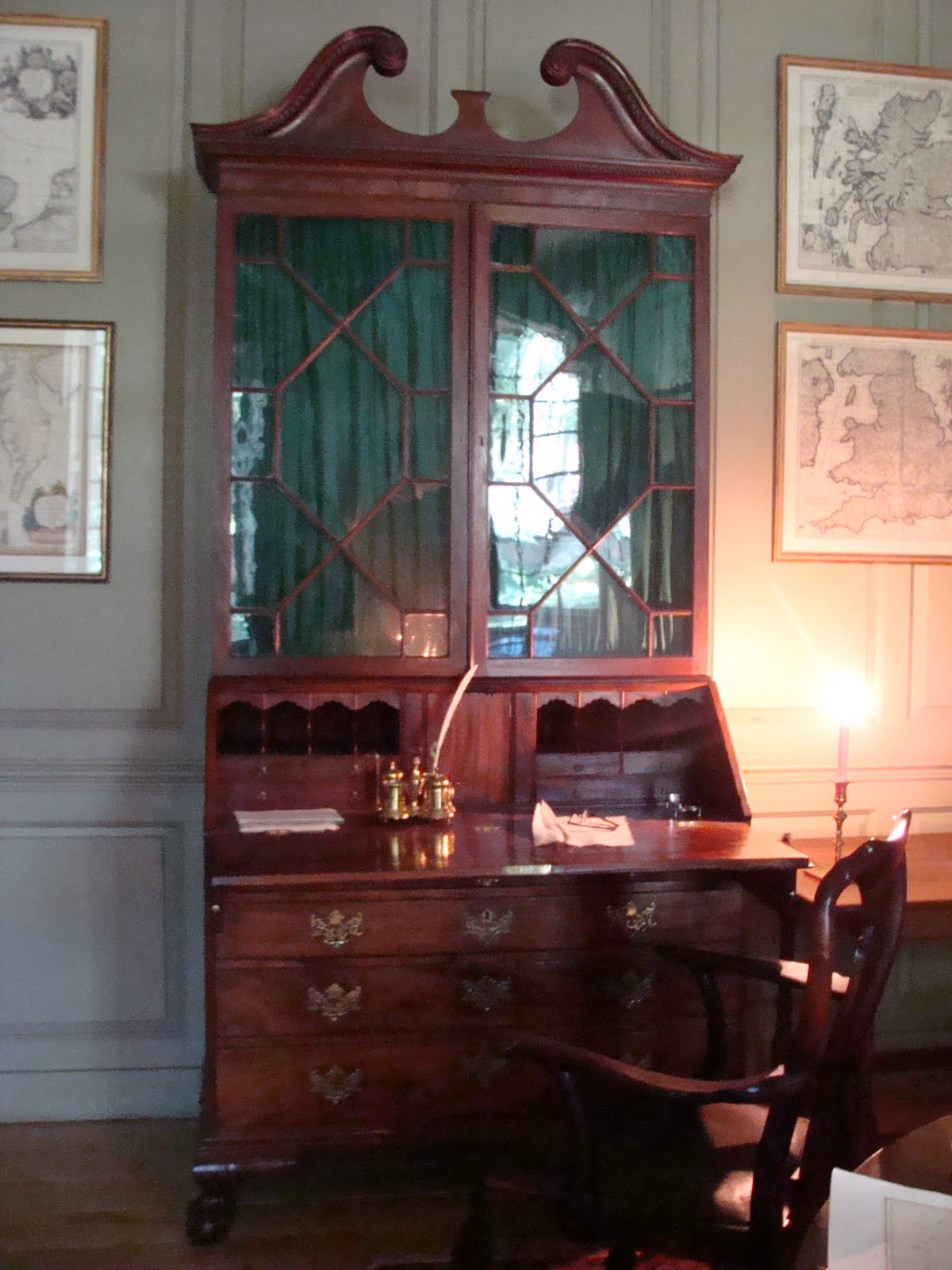
Walking through Wilton visitors might notice the countless pieces of period furniture on display throughout the house. Due to our wonderful collection, the most frequent question asked during tours is always “Is it a Randolph piece?” Visitors might be surprised that Wilton only boasts one original piece of furniture belonging to the Randolphs, and that is Peyton Randolph’s Secretary Desk currently on display in the Study. His great-granddaughter, and the last Randolph of Wilton, Catherine Randolph Mayo, bequeathed the piece to her son Robert Randolph Mayo. Robert’s wife, Betty, sold it to her nephew, John Brander, where it left the Randolph family line. He in turn sold it to his brother, Thomas Brander. The Dames purchased it from him around [1938], where it later became a centerpiece for the Study.
The desk was made sometime around 1770-80 in New York and it is attributed to Samuel Prince. Some of the fine craftsmanship includes: scrolled and dentil carved pediments; adjustable shelves and a slant front lid; and four graduated molded doors. It was made in the Chippendale style and is constructed out of Mahogany. The desk has some Poplar and White Pine in it as well. Secretary desks were first used in the 17th century and mark the beginning of permanent storage spaces over portable traveling pieces, such as traveling desks.  (See example below)

Peyton could have possibly used this desk in the very same room it is today.  From the 1815 inventory of Wilton it is very likely this desk resided in this very room. Peyton Randolph would have written his correspondences from this desk as well as taken care of the business aspect of running Wilton. When the Marquis de Lafayette stayed in the house for ten days during the Revolutionary War he could have used this very desk as well.
Bibliography:
Home Decorator's Collection. "'History of the Secretary Desk.'" Home Decorator's
               Collection, Decorating Ideas. Accessed July 1, 2011. Last modified 2011.
               http://www.homedecorators.com/ Decorating_Ideas/Buying_Guides/139.
Wilton House Furnishing Committee. "Report from the Furnishing Committee." Letter to
               the Item file, October 27, 1939 Wilton House Loan File Item #1938.2.  
Wilton House Museum. "Item file # 1938.2." Wilton House Museum to Researchers of
               the Collection, 1938 Collection file. http://www.buffaloah.com/f/glos/desk/deskstyles.html