Wednesday, September 11, 2013

An Element of Colonial Plantation Medicine

Object: Still
Accession #: 1951.10A-C


Recently featured on Antiques Roadshow's Facebook page, this 18th-century device was used for the distillation of spirits and medicinals. The copper body has two loops for lifting and a removable mushroom-shaped cap with an elongated spout. The person operating the still, usually the mistress of the house, would add the ingredients of her concoction to the body of the still and place it in its iron stand over a fire with the spout sticking out of the fire. The fire would boil the liquid in the base of the still and turn it into gas. This evaporated steam would collect in the top portion of the still and recondense into a liquid in the cooler spout portion, also called the "worm." The mistress would then collect the liquid that drips through the spout. This particular still originally came from Major Robert Beverly's plantation home, Blandfield. It is likely the "six gallon still and worm" Beverly ordered for the house in 1763. The large size of the fire required to heat this still suggests that it was used for spirits or in smaller quantities, medicine.


After the use of bloodletting and purgatives, medicinal or "physick" drinks were the next most popular colonial treatment for a variety of complaints. Due to the scarcity of doctors during this time in America, some medical knowledge was one of the expectations of colonial housewives. Jane Bolling Randolph, the mother of Ryland Randolph, was the author of a book of receipts (recipes) for both cooking and medicinal remedies known as the Commonplace Book. These remedies reflect a combination of herbal knowledge shared from Native American sources, superstition, the ancient European theory of disease arising from an imbalance of bodily humours, and some experimentation.

This simple recipe for the treatment of Whooping Cough comes from Every Man his own Doctor: or, The Poor Planter's Physician, written by Virginia practitioner John Tennant in 1734 [sic throughout]:
For this, boil Hysop and Elicampane, a Handful of each, in 2 Quarts of Water, strain it off, and adding 1 Pound of clean Muscovado Sugar, boil it again, and give the Patient 2 Spoonfuls every 3 hours.


Bibliography

Harbury, Katharine E. Colonial Virginia's Cooking Dynasty. University of South Carolina Press. Columbia, South Carolina: 2004.
Tennant, John. Every Man his own Doctor: or, The Poor Planter's Physician. Facsimile Edition by Printing and Post Office. Williamsburg, Virginia: 1984.

Image Credit


Wednesday, August 28, 2013

Light Horse Harry Lee's War Medal

Object: Coin, Commemorative Medal
Accession#: 2008.0017


This brass1 coin medal is after the original gold one, issued by Congress after the Battle of Paulus (Powles) Hook to Major Henry Lee, father of Robert E. Lee.  The front depicts a bust of Major Lee with Latin reading, “The American Congress to Henry Lee, Colonel of Cavalry.” The reverse shows ivy leaves encircling Latin which reads, “Nothwithstanding rivers and entrenchments, he with a small band conquered the foe by warlike skill and prowess and firmly bound by his humanity those who had been conquered by his arms. In memory of the conflict of Paulus Hook, nineteenth of August 1779.”


Henry Lee III, who became known as Light Horse Harry Lee, was born on January 29, 1756 on a 2,000 acre plantation called Leesylvania, near Dumfries, Virginia. His parents were Lucy Grymes Lee and Henry Lee II. Henry Lee III represented Virginia in the Continental Congress from 1786-88 and argued in favor of ratifying the Constitution in 1788. According to one historian “It was on the field of battle during the Revolutionary War, however, that Henry Lee III provided the most significant public service and earned his greatest laurels.” One of his best remembered victories, commemorated in this coin medal, was the Battle at Paulus Hook.


General Washington commanded Maj. Gen. Hugh Mercer to evacuate Paulus Hook after their loss at the Battle of Long Island on August 1, 1776 and the fall of New York City September 15, 1776. The British took over the fort and it became their only permanent stronghold in New Jersey. From 1776-1779, New Jersey was the scene of constant skirmishes and major battles. American morale was high following the successful assault of Stony Point by General Anthony Wayne, a British garrison with over 600 men defending the “rocky promontory rising 150 feet above the [Hudson] river,” in July 1776.  Major Lee wrote General Washington with the proposal to attack Powles Hook which was protected by the Hudson River on three sides and by a large marsh on the west that flooded at high tide. He gained Washington’s “cautious consent” after acquiring enough information about the garrison to plan the attack.

As Major Lee and his men approached the garrison, they found it weaker than expected, the main gate open in expectation of the return of a large Tory patrol. General Washington praised Major Lee’s victory that took place that day:

The General has the pleasure to inform the army that on the night of the 18th instant, Major Lee at the head of a party composed of his own Corps, and detachments from the Virginia and Maryland lines, surprised the Garrison of Powles Hook and brought off a considerable number of Prisoners with very little loss on our side. The Entreprise was executed with a distinguished degree of Address, Activity and Bravery and does great honor to Major Lee and to all the officers and men under his command, who are requested to accept the General’s warmest thanks.

However, not all were as generous with their praise but eventually Generals Woodford and Muhlenberg urged the court martial of Major Lee saying he should have turned the command over to Major Clark. They argued that Major Lee, a cavalry officer, should not have been placed in command of an infantry.

Despite his critics, Major Lee was awarded one of only nine medals in the whole war by Congress. The gold medal was directed to be struck and presented to him for “the remarkable prudence, address, and bravery, displayed on the occasion”. The medal was designed by Joseph Wright of Bordentown, New Jersey who was the first draftsman and die-sinker for the Philadelphia Mint, where it was struck. Major Lee was the only officer of his rank to receive such a distinction in the American Revolution.

The Randolphs of Wilton were well-involved with the American Revolution and would have heard of the attack on Paulus Hook as well as other victories during this struggle. Peyton Randolph, son of William III, was commissioned as a Major in the militia in 1777 and, according to the family, was also an aide-de-camp to General Lafayette.


1 an alloy of copper and zinc; known for its hardness and durability

Bibliography
Cecere, Michael. Wedded to my sword: The Revolutionary War Service of Light Horse Harry Lee
            Heritage Books Inc. Maryland, 2012.
Richardson, William H. and Walter P. Gardner. Washington and "the entreprise against Powles Hook". New             Jersey Title Guarantee and Trust Co. Jersey City, 1929.
“Battle of Paulus Hook”. HistoryNet.com. 26 July 2013. <http://www.historynet.com/battle-of-paulus-
            hook.htm>
“Brass”. Encyclopeadia Britannica. 15 August 2013.
            <http://www.britannica.com/EBchecked/topic/77876/brass>

Image Credit


http://www.nps.gov/museum/exhibits/revwar/image_gal/indeimg/lhenry.html

Wednesday, August 14, 2013

Conservation of Ryland

Object: Portrait of Ryland Randolph, c. 1756
Accession #: 1990.0012

Portrait of Ryland Randolph before conservation
Purchased in 1990, this portrait is a rare example of John Wollastan's English rococo style portraiture in colonial America. Wollastan traveled from England to America in the mid 18th century, painting portraits of wealthy Americans throughout the colonies in the style he introduced, characterized by graceful poses, pastel colors, and finely detailed costumes. Wollastan's trademark upturned lips and heavy-lidded, almond-shaped eyes are also evident in this portrait of Ryland Randolph, first cousin to Wilton's builder William Randolph III. Ryland's haughty appearance in the portrait fits with his reputation as a somewhat irresponsible landowner and planter who squandered his inheritance on his own interests. Unfortunately, the portrait's appearance at the time of its acquisition disguises theoriginal image through layers of overpainting and a deteriorated condition.

Pursuing conservation of this portrait was a priority of the Museum Board. After thoughtful study, and with community support, noted conservator Scott Nolley undertook the restoration of the portrait he described as a "long-obscured colonial masterwork."

Portrait during conservation: the upper right
quadrant shows the painting cleaned of dirt,
varnish, and overpainting
Ryland's portrait was completely painted over on two separate occasions: once around a century after its completion and again in the early 20th century. At some point in the past a doubtless well-meaning conservator trimmed the canvas around the image area and attached it to a linen backing. Unfortunately, this had begun to come loose, causing the surface to bubble and warp. Additionally, age contributed to crackling in the paint surface, the accumulation of dirt and the discoloration of varnish. Nolley removed each of these detrimental additions to Wollastan's original painting and stabilized it against future deterioration. The picture to the right showing Ryland's paler face is the original image with the dirt and unoriginal paint and varnish removed from the upper right portion. Below left is a picture showing the full portrait completely cleaned but with numerous areas of paint missing from Ryland's face, coat, and around the outside edge of the canvas. Below right shows the painting after Nolley inpainted these losses in a manner consistent with Wollastan's original version. Ryland Randolphs fully conserved portrait is currently on display in the Dining Room.


Ryland's portrait after cleaning,
showing areas of loss before inpainting 
Fully conserved portrait 


Bibliography:

Cowden, Gerald Stephen and College of William and Mary, Department of History. The Randolphs of Turkey Island: A Prosopography of the First Three Generations, 1650-1806. Ann Arbor, MI and London. University Microfilms International, 1977.

"John Wollastan." Early American Paintings in the Worcester Art Museum. 22 July 2013. <http://www.worcesterart.org/Collection/Early_American/>

Nolley, Scott. "Paintings Treatment Report." Unpublished internal document, 2003.


Image Credit:

Nolley, Scott. "Paintings Treatment Report." Unpublished internal document, 2003.

Wednesday, July 31, 2013

Fashionable Bedding

Object: Bedspread, c. 1780
Accession #:  1966.0002
White work flourished during the middle ages when the use of color was prohibited by church edicts as “excessive luxury in dress”. It is white stitching on white background and gained popularity in America until the 1790s when it was considered the symbol of the height of fashion. It was considered so fashionable to the point where some rooms were done all in white work. An example of white work is this English or American White Marseilles Coverlet with a Medallion surrounded By 16 Points and the Royal British Coat of Arms (Lion and Unicorn flanking the closed crown topped by St. George's Cross; “GR” under crown) in Wilton’s collection.
The designs on this particular Marseilles coverlet are significant. St. George was the patron saint of England. According to the apocryphal Acts of St. George, he held rank of tribune in the Roman Army and was beheaded by Diocletian c. 303 for protesting against the Emperor’s persecution of Christians. He was universally recognized as a saint sometime after 900. He had a widespread following and many miracles were attributed to him as well as a legend told of his slaying of a dragon. The banner of St. George, the red cross of the martyr on a white background was adopted for the uniform of English soldiers possible during the reign of Richard I, later became the flag of England and the White Ensign of the Royal Navy. It also has the Royal British Coat of Arms which was used as a national symbol for Great Britain and its reigning monarch.


White bedcovers were in fashion until the 1830s and were still being made in some rural areas as late as the 1850’s and 1860’s. This particular coverlet is a Marseilles coverlet. Marseilles quilts were made in the place of the same name in the South of France and imported to England and from there to the colonies throughout the eighteenth century. According to one historian, these carefully made Marseilles coverlets were “elaborately stuffed and corded, were usually all white and made of silk and linen although colors, and cotton and wool were sometimes used”. Their demand lessened with the 1763 English patent obtained for a loom-weaving process that produced woven cloth resembling the hand-stitched Marseilles quilting.
To hand-stitch white on white took a skilled needle worker and could take several years to complete. Most of this work would have been done during the day when the white on white stitches could be seen best. However, this coverlet in Wilton’s collection is thought to be made on a double loom to give it a quilted effect. The Randolphs would have desired to furnish their homes with the latest fashions and may have sought to adorn their bedrooms with white on white coverlets like this one with similar motifs.

Bibliography
Collins, Michael. “St. George”. Britannia. 4 May 2013.
<http://www.britannia.com/history/stgeorge.html>
Weissman, Judith and Wendy Lavitt. Labors of Love: America’s Textiles and Needlework,


1650-1930.  Random House. New York: 1994.

Wednesday, July 17, 2013

Something to Spice It Up


Object: Spice Grater, 1790-1850

Accession #: 2005.0016


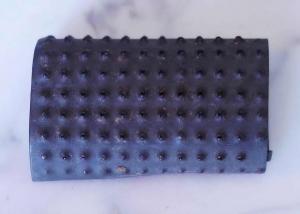
Spices were available to a certain extent in 18th century coastal cities and were sold whole to be cracked or ground at home. Ground spices would lose their aroma before being received by the consumer which is why they were sold whole. A spice grater, like this one found at Wilton, would have been used to grate the whole spices and could have been kept in one of the Randolph’s pockets for use. This one is free formed and punched from iron alloy sheet metal. According to one historian, “Spices were highly valued commodities in 18th century America—vital to food preparation, essential as preservatives of food and prized as medicines.” The search for better routes to the “spice rich lands of the East” is what motivated many of the explorations including Christopher Columbus’ voyage. The particular spice this grater is made for is nutmeg.


Described by one historian as the “quintessential spice”, nutmeg is the kernel of the apricot-like fruit of the tree Myristica fragrans and the soft membranous coat that covers its hard seed case is the spice, mace. These two spices were imported from the Spice Islands with clove. The desire of clove, mace, and nutmeg drove exploration to the original source of these spices which were islands on the Moluccan Sea. In a book written in 1880 called Medicinal Plants; being descriptions with original figures of the principal plants employed in medicine and an account of the characters, properties, and uses of their parts and products of medicinal value by Robert Bentley and Henry Trimen, nutmeg is mentioned as being “used with advantage in mild cases of diarrhea, flatulent colic, and certain forms of dyspepsia…” Spices such as nutmeg were used in food and nutmeg graters were produced beginning in the late 17th century with the growing popularity of serving punch: a brew of rum or brandy, fruit juice, sugar, and water laced with nutmeg and sugar.

Nutmeg Grater, Case and Cover
Acc#: 1968-72, A-B
1708-1708; Maker: Alexander Hudson
DeWitt Wallace Decorative Arts Museum
Graters were made of all shapes and sizes, some made suitable for carrying in the pocket and also fitted in a box to hold the nutmeg once grated. The availability of small graters, like this one, “eased [the] preparation” of punch. By the end of the seventeenth century one historian points out that “for fashionable Britons on both sides of the Atlantic, the drinking of warm beverages (coffee, tea, and chocolate), the adopting of polite dining practices in the French mode, and the serving of punch became highly organized social rituals”. The Randolphs would have kept up with these latest fashions and were served beverage cold this time of the year to combat the summer heat. 
Punch, as one historian asserts, “became the most popular mixed alcoholic drink of the 18th century.” This same historian discovered that William Byrd II of Westover Plantation wrote in his Natural History of Virginia, published in 1737, about the process of making punch. Byrd attests that “after which one has a very pleasant drink” and also recorded in his diary, November 16, 1737, while in London about being given a nutmeg grater as a gift. A member of the Randolph family would have been able to afford a fancier nutmeg grater than this one, possible made of silver (see above image) that fitted in a cylindrical box but that served the same purpose.

Bibliography

Davis, John D. The Robert and Meredith Green Collection of Silver Nutmeg Graters.
Googlebooks.com. 23 May 2013. <http://books.google.com/books?id=tD6zzh7Xfv4C&pg=PA8&source=gbs_toc_r&cad=4#v=onepage&q&f=false

Earle, Alice Morse. Home Life in Colonial Days. GoogleBooks.com. 23 May 2013.
<http://books.google.com/books?id=B2RWAAAAMAAJ&pg=PA158&lpg=PA158&dq=Colonial+Spice+Grater&source=bl&ots=qfcCMSquUA&sig=13WkMrpMsUdvwUDRA3x6ut5Nels&hl=en&sa=X&ei=NxfDUZLOM_ay4AO5yIGwDg&ved=0CFgQ6AEwCDgK#v=onepage&q=the%20table%20at%20meal-times%2C%20and%20the%20tiny%20ornamental%20graters%20which%20were%20carried%20in%20the%20pocket.&f=false>

“Nutmeg and Mace”. UCLA: History and Special Collections, Louise M. Darling Biomedical
Library. 18 May 2013. <http://unitproj.library.ucla.edu/biomed/spice/index.cfm?displayID=19>

“Spices in Early America: A Bicentennial Report”. Times Daily. 10 December 1974. Google
news. 18 May 2013.
<http://news.google.com/newspapers?nid=1842&dat=19741210&id=6v4rAAAAIBAJ&sjid=pccEAAAAIBAJ&pg=730,2825345>

“Nutmeg Graters”. ASCAS. 18 May 2013. <http://www.ascasonline.org/articolo11.html>.

Image Credit

http://emuseum.history.org/view/objects/asitem/search@/2/title-asc?t:state:flow=2118ed2f-282f-43d5-ba58-bdacffcc3ce0